
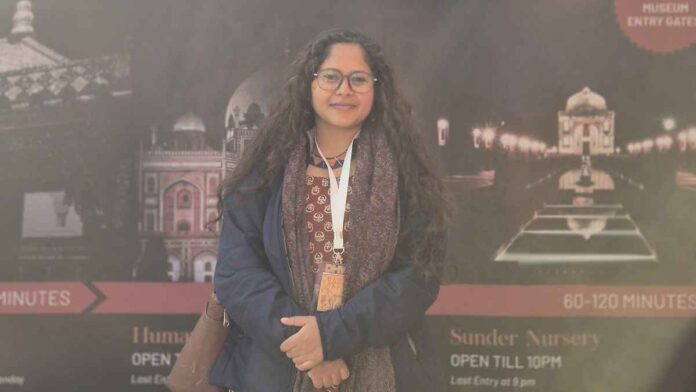
INDIA: Bastar is often reduced to a headline. Conflict, insurgency, and unrest dominate how the region is portrayed, leaving little space for the everyday lives, voices, and complexities of its people. For Jyoti Markam, who comes from Bastar and belongs to the Muria Indigenous community, this narrowing of reality was not just frustrating, it was formative.
A first-generation learner, Markam did not grow up imagining journalism as a career. In Bastar, she says, survival comes before ambition. Yet it was precisely this environment, shaped by routine and unacknowledged injustice, that pushed her toward writing. She watched stories about her people being told without consent, often stripped of context and reduced to stereotypes or statistics. Development was discussed without acknowledging displacement. Indigenous women’s experiences were either ignored or romanticised.
Also Read: Teen Chess Master Lorenzo Perea Puts International Stars on Notice
What drew her to journalism was the widening gap between lived reality and public narrative. Writing became a response to invisibility, a way to insist that stories from Bastar be told with accuracy, accountability, and dignity.
Today, Jyoti Markam works as an independent journalist, reporting on gender, Indigenous rights, climate justice, and land conflicts. Her work has appeared in publications such as The Caravan, Feminism in India, and The Mooknayak. Readers, she is often told, are struck not only by where she comes from, but by how she works, with careful reporting, factual precision, and ethical responsibility.
Markam’s journey into journalism was neither smooth nor planned. Her first article, she recalls, was emotionally raw and imperfect. Doubts followed quickly. She questioned whether her English was good enough and whether editors would take an Indigenous woman seriously. Some did not. Rejections were frequent, and so was self-doubt.
What kept her going was a simple but powerful realization. If people like her did not write their own stories, others would, often inaccurately or without accountability. Doing something different, she says, was not about bravery. It was about reaching a point where silence felt heavier than fear. Journalism became her way of refusing erasure and insisting on truth, even when that truth made readers uncomfortable.
Reporting on trauma, especially within one’s own community, carries an emotional cost. For Markam, learning to balance personal life with professional commitment has been an evolving process. Early on, she believed dedication meant constant availability, saying yes to every story and every deadline. Over time, that approach led to exhaustion.
Now, she works more intentionally. She builds routines outside journalism, including physical training, quiet reflection, and writing that is not meant for publication. These practices help her process what she witnesses and prevent her work from becoming purely reactive. Rest, she says, has become part of her professional discipline rather than a departure from it.
Difficulties, however, were not interruptions in Markam’s life. They were the landscape. Losing her father early, growing up with financial insecurity, and facing discrimination based on caste, color, and geography shaped her long before she had words to describe these experiences. Survival was not a phase but a condition.
The strongest influence in her life has been her mother. Markam watched her step out of a toxic marriage, rebuild life as a single parent, and continue after her father’s death without privilege or support systems. Her resilience was quiet and practical, never performative. That example continues to guide Markam’s approach to both life and work.
Even in progressive spaces, she encountered dismissal, particularly when her stories came from what were labeled “remote areas.” Instead of walking away, she sharpened her reporting, read more, listened more, and allowed rejection to teach discipline rather than bitterness.
To readers who want to do something different with their lives, Markam offers grounded advice. Privilege is not a prerequisite for dreaming differently, she says, but patience and courage are essential. The path may be slower and lonelier, but that does not make it wrong. Start where you are. Use the language you know. Tell the stories you understand deeply.
Most importantly, she urges, do not romanticise struggle or sacrifice your humanity. Rest when needed. Ask for help. Protect your dignity. Background, she believes, is not a limitation but a source of knowledge the world urgently needs.
Jyoti Markam does not write to be inspirational. She writes to be accurate. And in a media landscape crowded with noise and simplification, that commitment to truth has become, in itself, a form of hope.
Also Read: Suzanne Youngkin: A First Lady Driven by Faith, Service and Community