
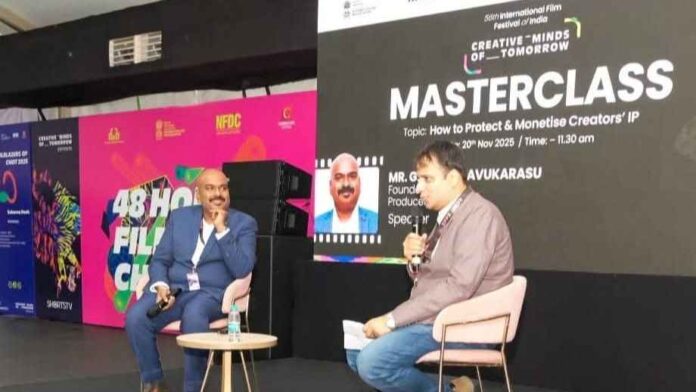
INDIA: Creative Minds of Tomorrow (CMOT) 2025 came to a vibrant close in Panaji, marking a standout moment at the 56th International Film Festival of India. The fifth edition of the initiative, aimed at nurturing India’s young filmmaking talent, delivered a dynamic mix of learning, mentorship and celebration. This year’s programme was elevated by the presence of noted film critic and cultural commentator Murtaza Ali Khan, who hosted all major ceremonies and moderated the festival’s highlight master-classes.
Khan’s involvement set a refined and engaging tone for the event. His reputation for insightful film analysis and his ease with global cinematic discourse made him an ideal anchor for the programme’s multiple sessions. From the moment he welcomed participants at the opening ceremony to the finale at the Marriott resort, his presence threaded a sense of coherence and sophistication through the festival’s diverse activities.
Also Read: Veteran Journalist K G Suresh Felicitated at IFFI for Role in Youth Filmmaking Jury
For the first time in CMOT’s history, every formal ceremony was anchored by a single host. Khan guided the proceedings with an articulate blend of authority and warmth, creating an environment in which young filmmakers felt both encouraged and inspired. His role extended beyond the stage as he facilitated conversations between participants and some of the film industry’s most celebrated professionals.
The master-class series proved to be among the most anticipated elements of CMOT 2025. Khan moderated richly informative sessions conducted by acclaimed cinematographer Kiran Deohans, acclaimed creative producer Supriya Nayak, internationally recognised filmmaker Bharat Bala, celebrated cinematographer GK Tirunavukarasu and award-winning director Stefano Casertano. Each mentor brought a distinct aesthetic and technical expertise, giving participants a rare opportunity to understand filmmaking through multiple lenses. The dialogues covered everything from the evolution of visual storytelling to the ethics of documentary production and the future of cinematic technology.
Participants described the master-classes as an invaluable platform for expanding their creative vocabulary. With Khan facilitating the discussions, the sessions maintained a balance between depth and accessibility, allowing emerging filmmakers to engage directly with industry veterans without hesitation. The atmosphere was marked by curiosity, generosity and a shared appreciation for cinema as a craft shaped by constant exploration.
The finale at the Marriott resort underscored the programme’s commitment to showcasing new talent. Film screenings for the Grand Jury and Great Grand Jury allowed participants to present their work to distinguished jurors, who evaluated entries across a range of categories. Jury deliberations that followed were focused and rigorous, reflecting the high calibre of entries curated from across India.
The evening’s award function drew an impressive gathering of participants, mentors, jury members and key figures from the film community. Senior officials, including Dr. Ajay Nagabhushan and Dr. K. K. Nirala, Joint Secretaries in the Ministry of Information and Broadcasting, joined NFDC Managing Director Prakash Magdum and ShortsTV CEO Carter Pilcher to felicitate the juries and recognise the achievements of the young filmmakers. Their presence highlighted the government and industry’s shared commitment to nurturing creative talent through structured platforms like CMOT.
Certificates were presented to all participating teams, acknowledging their dedication and the hours of effort behind each project. The ceremony also served as a gentle reminder that recognition in filmmaking goes beyond awards and extends to learning, collaboration and resilience. Ministry officials, NFDC leadership, IFFI representatives and ShortsTV dignitaries were on hand to congratulate the teams as they walked on stage to receive their honours.
The event concluded with a Vote of Thanks by NFDC General Manager Ajay Dhoke, who acknowledged the collective effort that made CMOT 2025 a success. He extended gratitude to the mentors, juries and participating teams, emphasising that the initiative’s strength lies in the collaboration between institutions and individuals committed to developing the next generation of storytellers.
Creative Minds of Tomorrow has, over its five editions, evolved into one of IFFI’s most influential talent development initiatives. The 2025 edition demonstrated how thoughtful curation, expert mentorship and structured engagement can help young filmmakers navigate the ever-evolving landscape of Indian cinema. With Murtaza Ali Khan’s steady presence guiding the ceremonies and discussions, the programme gained further stature, offering a polished and inclusive platform for creative expression.
As participants left Panaji with certificates, memories and new ideas, the essence of CMOT 2025 remained clear. It is not just a platform but a catalyst, encouraging India’s emerging filmmakers to refine their craft, embrace experimentation and prepare for the global stage.
Also Read: Piplantri’s Green Revolution Reaches Global Stage