
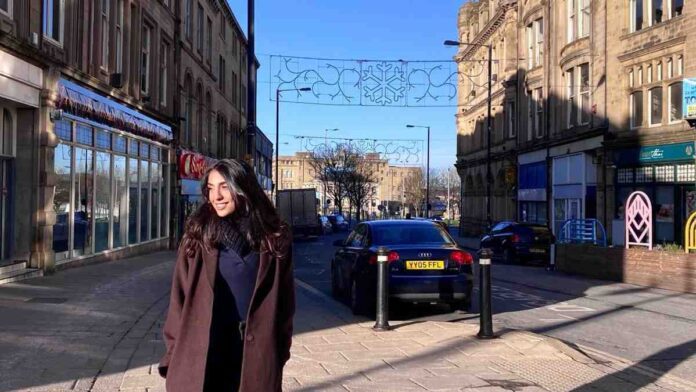
UNITED ARAB EMIRATES: Fatima Khand did not begin writing with the ambition of becoming an author. Her journey started quietly, in moments of solitude, when nights felt overwhelming and questions about identity and purpose weighed heavily on her. Writing, she says, became the only place where her thoughts could rest safely. Those private reflections eventually took shape as Walking to the Moon, a book rooted in doubt, healing, and the courage to keep moving forward without having all the answers.
Khand describes herself as someone who feels deeply and thinks endlessly, traits she once considered weaknesses. Writing transformed that belief. By putting her emotions on paper, she learned that softness can be strength and vulnerability something to embrace rather than hide. Her poems do not claim certainty or resolution. Instead, they mirror the uncertainty of life itself, offering reassurance that moving slowly and questioning everything is not failure, but part of growth.
Also Read: Suzanne Youngkin: A First Lady Driven by Faith, Service and Community
“I do not write from having all the answers,” Khand explains. “I write from doubt, healing, and the courage it takes to keep going even when clarity feels far away.” For her, writing is less about performance and more about honesty. Each poem serves as a reminder that even in darkness, there is always something worth walking toward.
Her motivation to do something different in life came not from a carefully laid plan, but from necessity. Writing was the safest space for her emotions, a place where confusion could be turned into meaning. She never intended to be published, nor did she see writing as a professional pursuit in the beginning. It was simply where her voice found strength when spoken words felt insufficient.
Walking to the Moon reflects that organic journey. Though some pieces are written through fiction, Khand says every chapter carries fragments of her life and experiences. Writing, for her, is not just a creative outlet. It is a way to preserve truth, share her voice, and leave behind something sincere.
Balancing her personal life with her passion has never been about strict separation. Alongside writing, Khand has been running her business for seven years, a responsibility she compares to raising a child. It requires discipline, structure, and constant care. Writing exists on the opposite end of that spectrum. It is unstructured, spontaneous, and free, something she carries with her rather than schedules.
“One grounds me, the other frees me,” she says. Rather than choosing between them, she has learned to let both coexist. While her business anchors her in reality, writing offers escape, reflection, and space to breathe. She continues to explore the writers’ community, eager to grow and belong, without stepping away from the professional world she has built.
Life’s difficulties have played a defining role in shaping her relationship with writing. A spine surgery, which she describes as a life altering and deeply frightening experience, forced everything to slow down. During that period of fear and vulnerability, writing became her anchor. Putting thoughts into words gave her a sense of control and helped her process pain, hope, and healing simultaneously.
That experience marked a turning point. Writing was no longer just something she enjoyed. It became something she needed. It revealed the power of self expression during life’s most fragile moments and reaffirmed her commitment to her craft.
Behind her resilience stands strong family support. Khand credits her parents and sisters for believing in her, especially during moments of self doubt. Their emotional and unconditional encouragement, she says, has been central to her ability to face challenges and continue pursuing her goals.
To readers who wish to do something different in life, Khand offers gentle but firm advice. Listen closely to what your heart is asking of you. Do not wait to have everything figured out before you begin. Life, she acknowledges, can be both beautiful and brutally hard, and everyone carries their own form of pain.
Through her poetry, she hopes readers feel seen and less alone. Her message is not about fearlessness, but persistence. Even slow steps count. Trust yourself, honour your feelings, and do not be afraid to walk a path that feels true. Sometimes, she believes, that is more than enough.
Also Read: Assam Writer Biswatosh Sinha Captures Lockdown Love in Debut Novel