
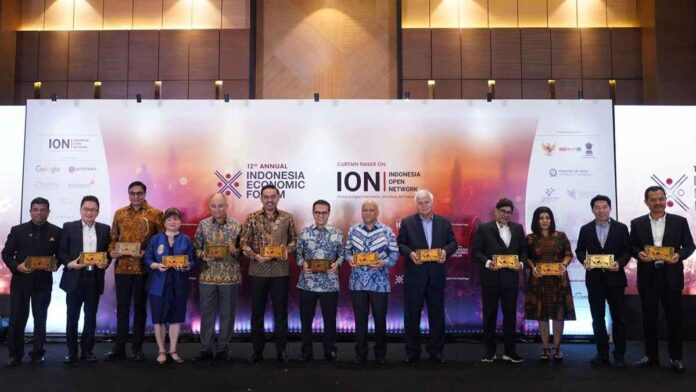
INDONESIA: The 12th Annual Indonesia Economic Forum, held under the theme “The Digital Archipelago,” marked a significant moment for Indonesia’s digital future. More than a routine gathering of policymakers, industry leaders, and technology innovators, the forum became a platform where national vision, digital infrastructure, and economic inclusion converged.
At the heart of the discussions was the launch of the Indonesia Open Network, widely known as ION, a new initiative aimed at reshaping the way digital commerce operates across the country. Designed as digital public infrastructure for commerce, ION seeks to create an open and interoperable ecosystem where businesses, consumers, and service providers can connect seamlessly.
Also Read: Teen Chess Master Lorenzo Perea Puts International Stars on Notice
Indonesia’s geography has always shaped its economic challenges. With more than 17,000 islands spread across a vast archipelago, the nation faces natural barriers to connectivity, logistics, and market integration. For decades, these physical constraints limited the ability of businesses in smaller towns and remote regions to fully participate in the national economy.
Today, the challenge has evolved from physical connectivity to digital connectivity. As Indonesia’s economy increasingly moves online, the focus has shifted toward ensuring that digital opportunities reach every corner of the country. The Digital Archipelago concept discussed at the forum reflects this shift. It represents a vision where technology bridges geographical divides and ensures that communities across islands, cities, and villages can participate in the digital marketplace.
Digital infrastructure is no longer defined solely by internet speeds or technological capacity. Policymakers and industry experts at the forum emphasized that the next phase of digital development must focus on inclusion, interoperability, and trust. These elements are essential if the digital economy is to benefit micro, small, and medium enterprises, commonly referred to as MSMEs.
Across Indonesia, millions of small businesses form the backbone of the economy. From farmers in Banyuwangi to artisans in Lombok and traders in Sorong, these enterprises contribute significantly to employment and local development. Yet many of them remain outside the reach of large digital platforms due to high costs, limited access to logistics networks, or dependence on closed digital ecosystems.
ION has been introduced as a solution to address these structural barriers. Unlike conventional digital marketplaces that operate as centralized platforms, the Indonesia Open Network is designed as a federated and open framework. It allows buyers, sellers, logistics providers, banks, and technology companies to connect through interoperable systems rather than through a single platform.
This open architecture enables different service providers to interact while maintaining competition and consumer choice. Businesses can select the platforms and services that best suit their needs while remaining connected to a broader digital commerce ecosystem.
Importantly, ION is not intended to replace or compete with existing platforms. Instead, it serves as an enabling infrastructure that allows multiple platforms to interact and exchange services. By reducing platform dependency, the initiative aims to lower entry barriers for smaller enterprises and encourage innovation among technology providers.
The forum also emphasized the importance of creating a balanced digital economy where growth is not concentrated among a few dominant players. While Indonesia has experienced rapid expansion in e-commerce, digital payments, and financial technology over the past decade, the benefits of this growth have not been evenly distributed.
Indonesia’s Vision for an Open and Inclusive Digital Economy
High customer acquisition costs and reliance on closed ecosystems have limited participation by many MSMEs. In several cases, small businesses struggle to maintain profitability on large platforms due to commissions, advertising expenses, and logistical constraints.
ION seeks to address these challenges by introducing a network-based model for digital commerce. Through interoperability standards, businesses will be able to interact across multiple platforms without losing access to customers or services. This approach encourages collaboration while preserving healthy competition among digital service providers.
The initiative was formally unveiled by Indonesia’s Minister of MSME, Maman Abdurrahman, who described ION as a transformative step for the country’s small business sector. Speaking at the forum, he highlighted how the network would complement the government’s SuperApp initiative, SAPA UMKM.
Together, ION and SAPA UMKM are envisioned as a comprehensive digital public infrastructure designed specifically to support MSMEs. The system will integrate commerce, payments, logistics, and digital services into a unified framework that enables businesses to operate efficiently across different platforms.
Minister Abdurrahman emphasized that this initiative represents a significant milestone in Indonesia’s economic strategy. He described the project as a potential game changer that could become the world’s first comprehensive digital public infrastructure dedicated to MSMEs.
The initiative also aligns with the government’s broader development roadmap known as Asta Cita, which focuses on strengthening economic inclusion and national competitiveness. By empowering small enterprises through digital networks, policymakers hope to accelerate Indonesia’s progress toward the long-term national vision of Indonesia Emas 2045.
Indonesia Emas 2045 marks the centenary of the nation’s independence and represents the country’s aspiration to become a fully developed economy by that year. Digital transformation is expected to play a central role in achieving this goal.
Participants at the Indonesia Economic Forum emphasized that building such a digital ecosystem requires collaboration across sectors. Government agencies, technology companies, financial institutions, startups, and civil society organizations must work together to ensure that digital infrastructure serves the entire population.
The discussions during the forum focused on practical implementation rather than theoretical ideas. Industry leaders examined how logistics networks, financial services, and innovation ecosystems can integrate with open digital frameworks like ION. The aim is to create an environment where digital commerce operates smoothly across geographical and institutional boundaries.
Experts also highlighted the importance of developing digital talent and strengthening technological capabilities within local communities. Ensuring that small businesses can effectively use digital tools will be essential to the success of initiatives like ION.
Ultimately, the concept of the Digital Archipelago reflects a broader vision of Indonesia’s digital future. Instead of relying on a single dominant platform, the country aims to create a collaborative network of platforms and services that work together to support inclusive economic growth.
By introducing the Indonesia Open Network, policymakers are taking a significant step toward transforming that vision into reality. If implemented successfully, the initiative could serve as a model for other countries seeking to build open and inclusive digital economies.
As Indonesia continues its journey toward Indonesia Emas 2045, initiatives like ION demonstrate how digital infrastructure can become a powerful tool for national development. Through cooperation, innovation, and open networks, the nation hopes to ensure that the benefits of the digital economy reach every island, community, and entrepreneur across the archipelago.
Also Read: Sudhanshu Karandikar Bridges India-Spain Emergency Care