
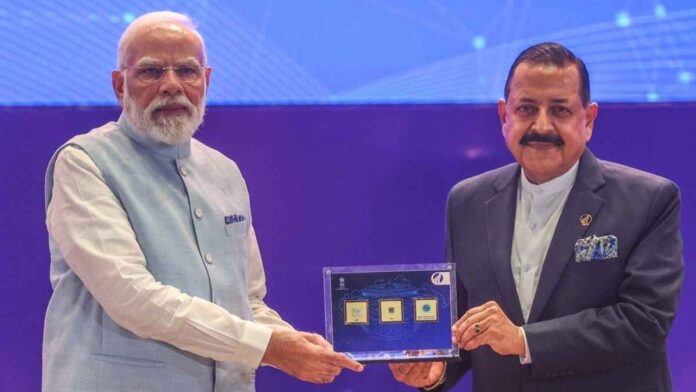
INDIA: In a major stride toward technological self-reliance, Prime Minister Narendra Modi on Tuesday inaugurated the ESTIC Conclave 2025, where India’s first Quantum Security Computing Chip was officially launched. Developed under the aegis of the Ministry of Electronics and Information Technology (MeitY), the chip marks a crucial milestone in India’s push for secure digital infrastructure and indigenous innovation.
ESTIC 2025 marked by India’s big deep-tech leap
Union Minister of Science and Technology, Dr. Jitendra Singh, hailed the moment as a “historic stride in India’s scientific journey,” highlighting the nation’s emergence as a global deep-tech leader.
“PM Sh @narendramodi gifts three pathbreaking innovations, developed by Indian innovators with the support of the Department of Science & Technology #DST:
- QSIP: India’s own quantum security chip
- 25-qubit QPU: India’s first quantum computing chip, powering the future of computation
- CAR-T Cell Therapy: India’s 1st indigenous cancer cell therapy
2 chips + 1 therapy – powerful breakthroughs that mark India’s rise as a global Science & Technology powerhouse,” Dr. Singh stated while addressing the inaugural session of the ESTIC 2025 conclave.
He added that these innovations not only demonstrate India’s growing self-reliance in frontier technologies like quantum computing and biotechnology but also signal the country’s readiness to lead the next wave of scientific transformation.
“Thanks PM Sh @narendramodi ji, for inaugurating the 3-day “Emerging Science, Technology, Innovation Conclave” #ESTIC2025, and launching the ₹1 Lakh Crore Research, Development & Innovation (RDI) Fund — a landmark initiative to strengthen India’s R&D and innovation ecosystem,” Dr Jitendra Singh wrote on social media platform X.
Over 38,000 GPUs, 3,000 datasets, and 30 AI solutions mark India’s rapid progress toward building a robust AI ecosystem.
Artificial Intelligence (AI) is no longer a futuristic concept in India—it is an active force reshaping education, healthcare, agriculture, and governance. At the centre of this transformation stands the Ministry of Electronics and Information Technology (MeitY), the nodal agency spearheading the country’s comprehensive AI strategy to ensure that technology serves every citizen responsibly and inclusively.
Also Read: From Fourth Place to World Champions: India’s Women Rewrite Cricket History
A Strategic Roadmap from Vision to Execution
India’s journey in AI policy began in 2018 with the launch of the National Strategy for Artificial Intelligence, followed by the creation of specialized committees to develop policy frameworks and promote AI-driven innovation. The subsequent National Programme on AI in 2019 structured these efforts across key domains—data, compute, skilling, and research.
On the global stage, India has positioned itself as a significant voice in responsible AI. As a founding member of the Global Partnership on AI (GPAI), the country has contributed actively to advancing human-centric and trustworthy AI practices. India also served as the Incoming Council Chair in 2022 and Lead Chair in 2024, reflecting its growing leadership in the field.
IndiaAI Mission: A Blueprint for Tech Sovereignty
The turning point came on March 7, 2024, when the Union Cabinet approved the IndiaAI Mission—a comprehensive national initiative aimed at boosting innovation, strengthening domestic capabilities, and ensuring tech sovereignty in the AI domain.
The mission is anchored around seven strategic pillars:
- IndiaAI Compute Capacity
- IndiaAI Foundation Models
- AIKosh – Dataset Platform
- IndiaAI Application Development Initiative (IADI)
- IndiaAI FutureSkills
- IndiaAI Startup Financing
- Safe & Trusted AI
Each pillar addresses a crucial component of the AI ecosystem—from compute infrastructure to ethics and safety.
Rapid Progress and Early Wins
In less than a year since its approval, the IndiaAI Mission has recorded significant milestones. Over 38,000 GPUs have been empaneled, available to users at a nominal rate of ₹65 per hour, ensuring affordable access to computing power.
Meanwhile, 12 proposals have been selected to develop foundational AI models tailored to India’s needs, and 30 AI solutions are under active development across priority sectors.
The AIKosh platform—India’s national AI datasets repository—has gone live with over 3,000 datasets, 240 models, 28 use cases, and contributions spanning 20+ sectors. To further strengthen the research ecosystem, 27 Data & AI Labs and 4 industry-partnered labs have been established.
In terms of talent, 200 students have already received IndiaAI fellowships, while 28 PhD candidates have been approved for IndiaAI Research Fellowships. Additionally, 13 projects under the Safe & Trusted AI initiative are currently being developed.
Building the Backbone: Compute and Language Infrastructure
Beyond the IndiaAI Mission, MeitY has launched several initiatives to strengthen the AI backbone of the country. The AIRAWAT-PSAI facility now provides 410 petaflops of mixed-precision peak compute capacity to startups, MSMEs, and researchers—empowering indigenous innovation.
Simultaneously, the Digital India Bhashini project under the National Language Translation Mission is enabling AI-driven translation across 22 scheduled Indian languages with 350+ AI models and 20+ language services, supporting the government’s vision of linguistic inclusivity.
Empowering Citizens Through Skilling and Access
Recognizing that AI success depends as much on people as on technology, MeitY has also prioritized AI skilling. The FutureSkills Prime platform offers a wide range of AI and machine learning courses—covering foundational to advanced concepts—with industry certifications and hands-on projects.
The government’s popular AI for All program has seen massive participation, with over 3 million learners completing the course in 11 Indian languages, helping democratize AI knowledge across communities.
“A Frugal and Inclusive Approach”
Commenting on the government’s approach to AI innovation, Shri S. Krishnan, Secretary, MeitY, said:
“We have adopted innovative means by learning from the experiences of others to build viable projects and products that will truly make a difference for us. In partnership with the private sector, accessible to the public sector—ensuring a level-playing field for all providers—is both innovative and frugal. It ensures that with the least amount of resources we are able to ensure availability for all. A number of international agencies have also found our approach very appealing, to build a model which can be used for the rest of the global South.”
AI for All, AI for the World
As India advances toward the Viksit Bharat@2047 vision, AI continues to play a pivotal role in shaping a digitally empowered future. MeitY’s initiatives are also integrated into the upcoming ESTIC 2025—India’s flagship science, technology, and innovation conclave—where AI will feature as a core thematic session.
The focus remains consistent and clear: AI for All, AI for India, and AI for the World. With strong institutional frameworks, open standards, and disciplined execution, India’s AI journey is steadily moving from prototypes to public good, turning innovation into empowerment and growth at scale.
Also Read: Alex Tzoulis: Building The Luxury Playbook Through Vision, Resilience, and Freedom