
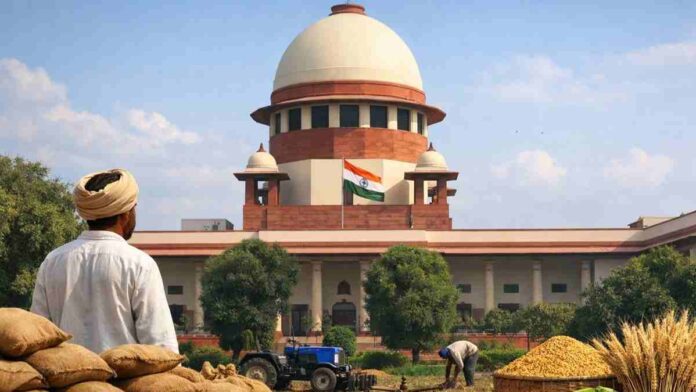
INDIA: In a significant development for India’s agrarian sector, the Supreme Court of India has sought a response from the Centre on a petition demanding that farmers be paid at least the weighted average cost of production for crops through a legally backed minimum support price system.
The plea, filed by farmer leader Prakash Pohare, argues that the current Minimum Support Price (MSP) declared by the government remains consistently below the comprehensive cost of production, leaving farmers in deep financial distress. The court issued notice to the Union government on April 13, 2026, and agreed to examine the concerns raised.
Also Read: Global Economy Shaken by Israel-US-Iran War, Trump Strategy Under Fire
Appearing for the petitioner, advocate Prashant Bhushan, along with Cheryl D’Souza and Shiyas K.R., told the court that farmers are often unable to recover even their basic input costs. They cited alarming data, including thousands of farmer suicides in Maharashtra over recent years, to underline the gravity of the crisis.
The petition explains that agricultural costs are calculated using multiple components, including input expenses, family labour, land rent, and interest on capital. These are collectively referred to as the comprehensive cost or C2. However, the MSP announced annually does not match this benchmark, the plea contends.
It also invokes the recommendations of the M.S. Swaminathan Commission, which had proposed that farmers be given at least 50 percent profit over their total cost of production to ensure viability. According to the petitioners, this recommendation has not been implemented in spirit.
Also Read: Berlin Artist Bridges Analog and Digital Worlds with Lacquer Art
The plea further raises concerns over a recently concluded trade agreement between India and United States, stating that reduced import duties could allow heavily subsidised foreign agricultural products to undercut Indian farmers. This, it argues, places domestic producers at a structural disadvantage.
Another key issue highlighted is the government’s dominant role in procuring staple crops such as wheat and rice under the National Food Security Act. While acknowledging the welfare objective of subsidised food distribution, the petition claims it has distorted agricultural markets and reduced demand for alternative crops like millets.
The legal challenge also links current demands to a longer history of farmer mobilisations, particularly in the Vidarbha region. Pohare credited sustained grassroots protests and advocacy for earlier policy shifts, including the landmark farm loan waiver.
Also Read: From Village Roots to Regional Growth: Dhansing Barve Advances Footwear Legacy
He recalled that the demand for loan relief gained national traction after a 2006 meeting with then Prime Minister Manmohan Singh, alongside veteran Gandhian Mohan Dharia. When initial assurances did not translate into action, the leaders launched a fast in Pune, triggering widespread protests across Vidarbha.
Persistent reporting by regional media, particularly Deshonnati, and growing national attention to farmer suicides eventually led the government to set up the Radhakrishnan Committee to assess rural indebtedness. The findings paved the way for a nationwide loan waiver, later described as “revolutionary” by then Agriculture Minister Sharad Pawar.
Pohare and other farmer leaders maintain that the true credit for such measures lies with the thousands of farmers who lost their lives amid mounting debt, calling them “martyrs” of the movement.
With the Supreme Court now stepping in, the case is expected to reignite debate over agricultural pricing, state support, and the long-term sustainability of farming in India.
Also Read: Marc Rompf and Marcel Ramin Derakhchan Drive dla with Vision and Purpose