
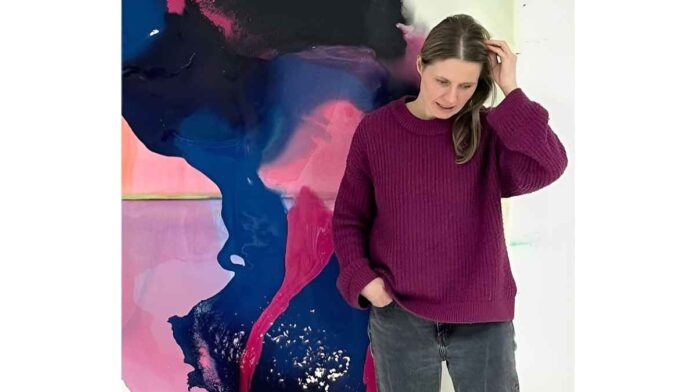
GERMANY: Berlin-born and Hanover-based artist Anna Beller has been steadily transforming the landscape of contemporary abstract art through her unique “Lacquer Works” series. With a background in architecture and experience in computer-aided design across Switzerland and the UK, Beller brings a meticulous, experimental approach to color, texture, and material behavior. Since beginning the ongoing series in 2023, she has combined technical precision with the unpredictability of lacquer, producing works that resonate in both traditional galleries and the rapidly growing digital art ecosystem.
The “Lacquer Works” series is defined by its exploration of color layering and pigment flow. Beller’s process begins with guided yet spontaneous applications of lacquer; drips, pours, and spreads that are allowed to interact naturally. The resulting compositions emerge from the material itself: pigments settle, merge, and form gradients and textures that cannot be fully anticipated. Extended drying times allow motion to become frozen in stasis, creating visual tension between deliberate artistic input and the autonomous behavior of the medium. Untouched areas of white ground provide optical space, allowing color masses to float, creating a sense of both suspension and vibrancy.
Also Read: From Village Roots to Regional Growth: Dhansing Barve Advances Footwear Legacy
Beller’s architectural training informs her approach, particularly in the controlled layering and rhythmic repetition of forms, drawing subtle inspiration from abstract expressionist pioneers such as Helen Frankenthaler and Morris Louis. Like their soak-stain techniques, Beller’s lacquer pieces emphasize transparency, flow, and the balance between control and accident. However, her adaptation of these principles to lacquer, a medium noted for its viscous and reflective qualities, creates a distinctive aesthetic that is at once minimal, meditative, and dynamic.
Collaborations and Exhibitions Amplify Artist Visibility
The series gained additional momentum through its digital iteration. Beginning in 2022, Beller ventured into the NFT space on the Tezos blockchain, inspired by artists like Amber Vittoria who demonstrated that minimalist abstraction could thrive online. Rather than reproducing physical canvases, she created original digital works, including her “Sketchbook” series, which layered iPad drawings with digital patterns. This approach allowed her to translate the fluid, layered qualities of lacquer into a digital format that resonated with collectors interested in process-based abstraction. Platforms such as Verse, objkt.com, and Foundation hosted her early digital editions, bridging the gap between analog creation and blockchain distribution.
The physical “Lacquer Works” have attracted significant attention from collectors and institutions. They are part of prestigious holdings such as artothek Hannover, Haus der Region Hannover, the Holtmann collection in Hanover, the Michael Spalter collection in the United States, and the Arab Bank Switzerland in Geneva. Several pieces have also been included in the Anne + Michael Spalter Digital Art Collection, emphasizing her dual presence in both traditional and crypto-based spaces. Collaborations and exhibitions with platforms like Verse and Expanded Art have further amplified her visibility, positioning Beller at the intersection of material innovation and digital experimentation.
Beller treats her physical and digital practices as complementary rather than competitive. In interviews, she has emphasized the natural fit of digital formats for contemporary art. NFTs, she notes, provide advantages including lower material costs, direct access to collectors, and the ability to earn royalties on secondary sales. They also allow her to reach younger, tech-savvy audiences while maintaining creative independence outside traditional gallery systems. While challenges remain, such as defining a digital voice distinct from physical work and educating collectors about the hybrid nature of her practice, Beller’s success demonstrates the potential for painters to thrive in Web3 and other digital ecosystems.
In 2026, “Lacquer Works” continues to evolve. Recent explorations have focused on minimal red tones and experiments with paper substrates, extending the tactile and visual possibilities of her medium. Each piece reflects a careful negotiation between controlled input and material autonomy, while her digital counterparts translate these qualities into blockchain-friendly forms that can be shared, collected, and traded. By doing so, Beller has crafted a body of work that challenges traditional definitions of painting and demonstrates how hybrid practices can expand the reach of contemporary abstraction.
Beller’s approach has broader implications for the art world. Her work encourages a rethinking of how artists can navigate physical and digital realms, using color as an active force rather than a passive element. The success of “Lacquer Works” in both gallery and blockchain contexts highlights an emerging model for contemporary practice: one that embraces technological innovation without abandoning material exploration. Young artists and collectors alike are taking note, recognizing that process-driven abstraction can thrive in multiple formats, and that traditional techniques can inform, rather than be replaced by, digital experimentation.
Also Read: From Village Struggles to City Dreams Aarti Tiwari’s Journey of Resilience
The “Lacquer Works” series, with its fluid textures, subtle gradients, and interplay of control and chance, exemplifies a shift in contemporary art toward hybridization. Anna Beller’s practice demonstrates that painters can maintain a strong presence in analog spaces while embracing the opportunities of digital platforms. Her work is an invitation to reconsider the role of color, material, and process in an increasingly interconnected art world, where physical and virtual experiences intersect and enrich each other.
Through the continued evolution of “Lacquer Works,” Beller is shaping a narrative in which contemporary abstraction is not confined to canvas or gallery walls. By translating the dynamic properties of lacquer into both physical and digital forms, she bridges the traditional and the innovative, providing a roadmap for artists seeking to explore the full potential of hybrid creativity. In doing so, she is redefining what it means to be a painter in the 21st century, proving that the boundaries between analog and digital are not limitations but opportunities for expansion and experimentation.
Beller’s pioneering approach underscores the ongoing relevance of material experimentation in an era increasingly dominated by digital media. It also suggests that the future of painting may lie not in choosing between physical and virtual forms, but in skillfully navigating the intersection of both. With “Lacquer Works,” Anna Beller has carved out a space where color, texture, and technology converge, capturing the attention of collectors, institutions, and digital art enthusiasts alike.
Her work, spanning continents and media, ultimately celebrates color as a living, interactive force capable of transcending traditional boundaries. By merging analog techniques with digital innovation, Beller offers a compelling vision for contemporary art; a vision that is immersive, collectible, and profoundly modern.
Also Read: Grant Thornton Portugal Strengthens Services With Legal Practice