
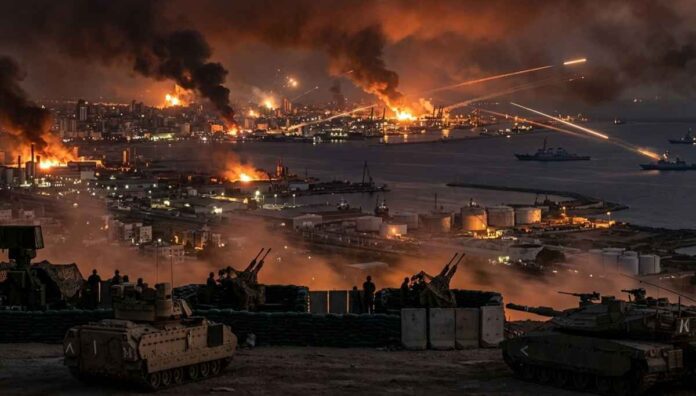
As the conflict between the United States, Israel, and Iran stretches into its second week, global attention is fixed on a rapidly deteriorating situation. What began on February 28, 2026, as a series of surprise airstrikes has evolved into a multifaceted crisis, drawing in proxy forces and threatening international stability. The war, marked by intense aerial bombardments, missile attacks, and disruptions to vital trade routes, has already claimed thousands of lives and displaced millions. Analysts warn that the confrontation could reshape geopolitical alliances and economic landscapes for years to come.
Roots of the Conflict: A Powder Keg Ignited
The origins of this war lie in decades of simmering tensions over Iran’s nuclear ambitions and regional influence. For years, the United States and Israel have regarded Iran’s ballistic missile programs and support for proxy militias as existential threats. The collapse of the 2015 Joint Comprehensive Plan of Action under the Trump administration in 2018 removed constraints on Iran’s nuclear program, setting the stage for renewed hostilities.
A brief but intense 12-day conflict in 2025 between Israel and Iran highlighted these frictions. During that clash, Israel conducted more than 1,000 sorties targeting Iranian nuclear facilities, while Iran responded with hundreds of missile and drone attacks, most intercepted. However, the conflict failed to dismantle Iran’s nuclear and missile capabilities, fueling further resentment and military preparations.
Also Read: Harsh Agrawal and Keetabi Keeda: Turning Books into a Digital Conversation
The current war erupted on February 28, 2026, when the United States and Israel launched coordinated airstrikes across Iran. Key military installations, including missile launchers, naval assets, and nuclear sites like the Taleghan facility, were targeted. In a striking escalation, the strikes killed Iran’s Supreme Leader Ali Khamenei along with dozens of senior officials. Israeli Defense Minister Israel Katz confirmed the operation had been planned since November 2025. US President Donald Trump justified the attacks as necessary to prevent Iran from obtaining nuclear weapons, destroy its missile arsenal, and potentially facilitate regime change by empowering internal opposition.
Israeli officials echoed this stance, warning that delays would have allowed Iran to rapidly advance its nuclear program. Critics argue that the strikes constituted a war of choice, not necessity, noting that Iran’s pre-attack actions had been largely defensive, focused on rebuilding after the 2025 war. Underlying the military rationale are broader geopolitical dynamics. Iran’s alliances with Hezbollah in Lebanon and the Houthis in Yemen have extended its influence across the Middle East, challenging US and Israeli dominance. Meanwhile, the US shale revolution has reduced Washington’s dependence on Middle Eastern oil, emboldening bolder actions but failing to shield the global economy from ripple effects.
Iran’s Stance: Defiance Amid Devastation
Iran’s response has been swift and multifaceted. Following Khamenei’s death, a leadership council assumed control, with his son, Mojtaba Khamenei, emerging as the new supreme leader. State media indicates he is preparing his first public address, signaling continuity in Iran’s hardline policies.
Militarily, Iran has launched waves of ballistic missiles and drones at Israeli cities, US bases in Iraq, Qatar, Bahrain, and the UAE, and critical oil infrastructure. In addition, Hezbollah has opened a second front by firing rockets into Israel, prompting retaliatory strikes on Beirut. Houthi forces have intensified attacks on shipping in the Red Sea, complicating global trade.
Iran’s strategy emphasizes asymmetric warfare, leveraging proxy forces to stretch US and Israeli capabilities. Brigadier General Ebrahim Jabbari of the Islamic Revolutionary Guard Corps warned that vessels in the Strait of Hormuz, a chokepoint for one-fifth of global oil trade, would be targeted. The threat quickly materialized, with Iran effectively closing the strait to commercial traffic, stranding hundreds of tankers and halting shipments.
Internally, Iran faces significant challenges but shows no signs of imminent collapse. US intelligence indicates the government remains stable despite bombardment, which has displaced up to 3.2 million people. Dissidents argue that airstrikes alone cannot topple the regime, citing deep-rooted state control and public resistance to foreign intervention. President Masoud Pezeshkian emphasized that attacks target US assets, though evidence suggests broader strikes on regional bases.
Internationally, Iran benefits from support from Russia, which is sharing intelligence to aid strikes on US forces, and potentially China, which may provide financial and material support, including missile components. This backing positions Iran as a counterweight to Western influence, complicating prospects for rapid de-escalation.
Global Repercussions: A World on Edge
The war’s consequences extend far beyond the Middle East, threatening global security, economies, and diplomacy. Energy markets have been severely impacted, with oil prices surging more than 5 percent in the early days of the conflict and the potential to reach $100 per barrel if the Strait of Hormuz remains closed. Gas prices in the UK have doubled within a week, while petrol and diesel costs are rising worldwide, straining household budgets and industrial operations. Gulf states, major suppliers of crude to China, are under attack, heightening vulnerabilities in emerging economies.
Trade disruptions have been significant. The closure of the strait and attacks on shipping have forced reroutes, delaying goods from food to automobile components and inflating costs. Merchant ships, including those operated by Hapag-Lloyd, have been struck, placing civilian crews in danger. Global stock markets have fallen sharply, with Dubai’s index leading losses amid fears of a prolonged conflict.
Travel has also been disrupted. Middle Eastern airspace closures have stranded tens of thousands of passengers and forced the cancellation of over 40,000 flights, marking the worst disruption since the COVID-19 pandemic. Jet fuel costs have outpaced crude prices, straining airlines and prompting government-organized repatriation efforts.
Security risks continue to rise. Iranian strikes on US bases have exposed American personnel, raising concerns about escalation into wider regional war. Gulf nations hosting US forces are reassessing alliances, while cyberattacks and misinformation campaigns complicate the strategic landscape. Experts predict that stalemates, trade bottlenecks, and potential chemical or deceptive attacks could escalate tensions further by mid-April.
Humanitarian tolls are staggering. Approximately 2,000 deaths have been reported, with millions displaced in Iran. The United Nations warns of a worsening crisis, while the US has spent over $11 billion on military operations in under two weeks.
Geopolitically, the conflict underscores a multipolar world. China faces a delicate balancing act between supporting Iran and managing economic fallout, while Russia’s assistance to Tehran signals waning US hegemony. European nations have called for diplomacy to secure trade routes and energy flows. Analysts note that the war may redefine alliances based on regional interests rather than traditional East-West divisions.
Uncertain Horizons
As airstrikes continue and Iranian countermeasures persist, the path to de-escalation remains unclear. US Central Command reports a 90 percent drop in Iranian missile attacks, though Iran is believed to retain 100 to 200 launchers. Diplomatic efforts have stalled, with leadership strains evident on all sides. President Trump has demanded unconditional surrender from Tehran, but experts doubt that airstrikes alone can achieve regime change.
The global community braces for prolonged impacts. Economic shocks, disrupted trade, and security uncertainties will continue to affect multiple regions. Analysts warn that this war, born from deep-seated rivalries, tests the resilience of international systems and demonstrates how quickly regional disputes can escalate into worldwide crises.
The unfolding conflict between the United States, Israel, and Iran is far from resolved. With mounting casualties, economic disruptions, and the involvement of multiple global powers, the crisis could redefine political and strategic calculations in the Middle East and beyond for years to come.
Also Read: Teen Chess Master Lorenzo Perea Puts International Stars on Notice