
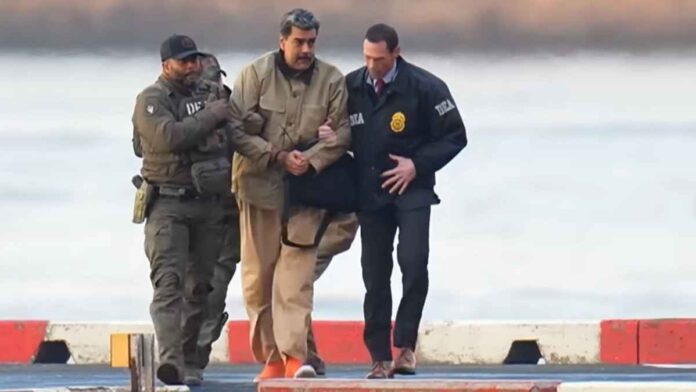
VENEZUELA: In an extraordinary turn of events that has reverberated across the Americas and the world, Venezuelan President Nicolás Maduro was removed from power in early January after a bold military operation carried out by the United States. The sudden fall of a leader who ruled Venezuela for more than a decade has elicited both cheers and condemnation, exposing deep divisions over sovereignty, democracy, and foreign intervention.
The moment Maduro was captured and flown to the United States to face charges in federal court marked a watershed in Venezuelan history. For many Venezuelans and political exiles around the world, it was the culmination of years of struggle against what they widely describe as an authoritarian regime.
Also Read: Spanish Writer Maho Cañizal Explores Power and Love in Her Debut Novel
Who Is Nicolás Maduro? A Leader, But Also a Symbol of Crisis
Nicolás Maduro rose from humble beginnings as a bus driver and union organizer to become a close ally of Hugo Chávez, the charismatic socialist president who governed Venezuela from 1999 until his death in 2013. Maduro succeeded Chávez in 2013 and quickly consolidated power. Over the next decade, his government was accused of widespread corruption, human rights abuses, and economic mismanagement. Deep political polarization followed the collapse of Venezuela’s oil-dependent economy, leading to shortages of food, medicine, and basic services. Hundreds of thousands of Venezuelans were killed or forced to flee the country.
Under Maduro’s watch, elections were widely criticized as unfair by international observers, opposition leaders were jailed or driven into exile, and independent media faced censorship. Human rights groups and the United Nations documented numerous violations under his administration, including suppression of protests and political intimidation.
For many of his critics, Maduro embodied authoritarian rule and the collapse of democratic norms. They argued that the political system was engineered to keep him in power regardless of popular will. In response, Maduro and his supporters insisted that foreign powers, especially the United States, sought to undermine Venezuela’s sovereignty and overthrow its government under the pretext of democracy.
Why the United States Intervened
Relations between the United States and Nicaragua’s government had been fraught for years, involving a mixture of diplomatic pressure, sanctions, and legal actions. In 2025 and 2026, these tensions escalated dramatically after a disputed 2024 Venezuelan presidential election and mounting allegations that Maduro’s government was complicit in transnational drug trafficking and other criminal networks. The Trump administration placed a sizable bounty on Maduro’s arrest for alleged narco-terrorism and illegal drug imports, painting him as a global criminal.
When Maduro refused repeated ultimatums to step down and rejected offers of safe passage out of Venezuela, the U.S. launched a large-scale strike that resulted in his capture. U.S. officials called this action necessary to protect regional stability, uphold the rule of law, and support the aspirations of Venezuelans demanding democratic reform. President Donald Trump announced that the United States would assume temporary administrative control until a transitional government could be established.
Also Read: French Influence Awards 2025 Honor Global Ambassadors at Quai d’Orsay
Critics of the intervention, including many world leaders and international legal scholars, lambasted the operation as a violation of international law and national sovereignty. They warned that it could set a dangerous precedent for foreign incursions into other countries’ affairs.
Liberation or Invasion? Venezuelan Views Diverge
Inside Venezuela, reactions to Maduro’s ouster are complex and varied. Many citizens, especially those who endured years of economic hardship and repression, celebrated the news with expressions of hope and joy. Images and statements from Venezuelan communities abroad described crowds cheering “Libertad” and chanting for freedom after what they viewed as liberation from dictatorship. Opposition leaders hailed the moment as the beginning of a new chapter for democracy.
For Venezuelans living outside the country’s borders, celebrations were visible in cities across the United States where diaspora communities gathered to mark what they described as a long-awaited end to authoritarian rule.
However, not everyone shares the same view. Inside Venezuela, reports indicate that the situation remains tense and volatile. Pro-government paramilitary groups, loyal to the ousted president, have taken to the streets to assert control and suppress dissent. Authorities loyal to Maduro’s regime have deployed armed “colectivos,” arrested journalists, and declared states of emergency to maintain order and push back against celebrations perceived as threats to national unity.
The Struggle for Venezuela’s Future
In the power vacuum left by Maduro’s departure, Venezuela’s political destiny is far from certain. Delcy Rodríguez, Maduro’s vice president, was sworn in as interim president by the Supreme Court, rejecting claims that Venezuela is under external control. Russia, a longtime ally, publicly supported Rodríguez’s government and condemned what it framed as neocolonial threats.
Meanwhile, opposition figures such as María Corina Machado, a prominent leader who has championed democratic change for years, called for the restoration of democratic institutions and the release of political prisoners. Machado described Maduro’s capture as an “hour of freedom” for Venezuela and outlined plans for transitional governance.
The immediate challenge for Venezuela will be to reconcile deep political rifts, revive a shattered economy, and establish credible governance structures that reflect the will of its people. For many Venezuelans who have suffered under prolonged crisis, the prospect of free elections, restoration of civil liberties, and return of exiles offers a glimmer of hope.
A Nation at a Crossroads
As international reactions pour in and the world debates the legality and consequences of the U.S. intervention, ordinary Venezuelans face their own moment of truth. After years of hardship, displacement, and fear, many are ready to embrace change and reclaim a future defined by democratic choice rather than authoritarian rule.
Whether Venezuela’s celebrated moment of perceived freedom will lead to lasting stability remains uncertain. Yet for those who have long opposed Maduro’s government, the end of his rule represents a historic shift and a new beginning in their pursuit of human rights, justice, and self-determination.
Also Read: Suzanne Youngkin: A First Lady Driven by Faith, Service and Community