
Home Blog Page 41

Unlocking the Mysteries of Evolution: Understanding Muller’s Ratchet

INDIA: In the intricate dance of evolution, scientists have discovered a fascinating phenomenon called Muller’s Ratchet. Named after the esteemed geneticist Hermann Joseph Muller, this concept sheds light on the accumulation of harmful mutations in asexual populations over time.

Muller’s Ratchet provides valuable insights into the mechanisms underlying the preservation of genetic information and the challenges organisms face in maintaining their genetic integrity.

At the heart of Muller’s Ratchet lies the process of asexual reproduction. Unlike sexual reproduction, which allows for the shuffling and recombination of genetic material, asexual reproduction involves the replication of an organism’s DNA without exchanging genetic information with a partner. 

This lack of genetic recombination can be detrimental when purging harmful mutations from a population. The ratchet effect occurs due to the accumulation of deleterious mutations in the genomes of asexual organisms. Mutations, which are random changes in the DNA sequence, can harm an organism’s fitness and survival. 

In sexual populations, the constant mixing and reshuffling of genetic material through recombination provides opportunities to weed out these detrimental mutations. 

However, in asexual populations, there is no efficient mechanism for purging harmful mutations. Muller’s Ratchet describes how harmful mutations gradually accumulate in asexual populations. 

As each generation reproduces asexually, detrimental mutations can increase irreversibly. This accumulation results in a downward spiral of genetic fitness, leading to reduced population viability and eventual extinction.

To understand Muller’s Ratchet, imagine a hypothetical population of asexual organisms. Initially, each organism possesses several deleterious mutations, represented by “ratchet clicks.” 

With each subsequent generation, the Ratchet clicks forward, adding more harmful mutations to the population. Since asexual reproduction does not allow for the removal of these detrimental mutations, they continue to accumulate relentlessly.

The consequences of Muller’s Ratchet are far-reaching. It poses significant challenges for asexual populations to adapt to changing environments and maintain genetic diversity. 

Without the recombination mechanism, asexual organisms cannot eliminate harmful mutations and introduce new genetic variations into their gene pool.

However, nature has devised strategies to counteract the effects of Muller’s Ratchet. Some asexual organisms possess mechanisms like horizontal gene transfer, where they acquire genetic material from other organisms or endogenous viral elements that can introduce genetic diversity. 

These mechanisms offer a glimmer of hope in the face of Muller’s Ratchet, enabling asexual populations to mitigate the accumulation of harmful mutations to some extent.

Studying Muller’s Ratchet has profound implications for understanding evolution dynamics and the long-term survival of different species. It highlights the significance of sexual reproduction in generating genetic diversity and purging deleterious mutations from populations. 

Muller’s Ratchet serves as a cautionary tale, emphasizing the importance of maintaining genetic variation to enhance the adaptive potential of organisms.

While Muller’s Ratchet presents challenges for asexual populations, it also underscores organisms’ unique mechanisms and strategies to ensure survival. 

Through ongoing research and exploration, scientists continue to unravel the complexities of Muller’s Ratchet, enriching our understanding of evolution and the fundamental processes that shape life on our planet.

Also Read: Russell’s Paradox: The Mind-Boggling Self-Referential Conundrum of Classic Mathematics

Anatomy of the Illusion: Understanding Anscombe’s Quartet and Statistical Deception

INDIA: In the world of statistics, numbers can often paint a deceptive picture. One classic example that exposes the limitations of relying solely on statistical measures is known as Anscombe’s Quartet.

This Quartet of datasets, devised by British statistician Francis Anscombe in 1973, challenges our perception of data and highlights the importance of visual analysis.

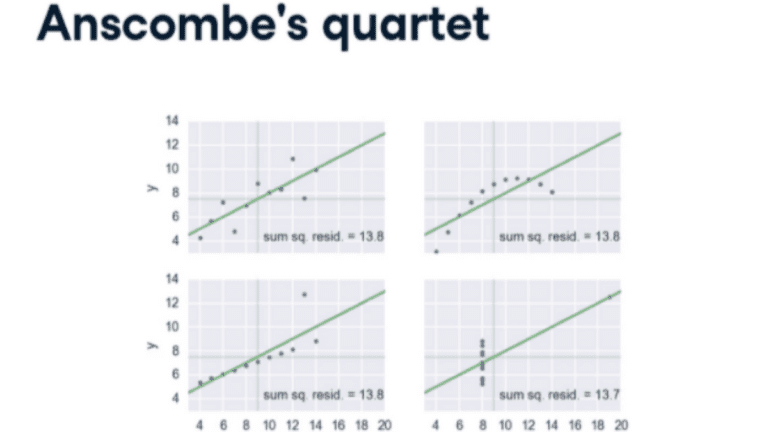
Anscombe’s Quartet consists of four distinct datasets with 11 data points. At first glance, these datasets appear to have similar statistical properties, with nearly identical means, variances, correlations, and linear regression parameters. However, when plotted, they reveal startling differences.

The power of Anscombe’s Quartet lies in its ability to demonstrate the dangers of relying solely on summary statistics without considering the underlying data distribution. Let’s explore each dataset in detail:

Dataset I: This dataset exhibits a perfect linear relationship between the x and y variables. A linear regression model would fit the data accurately, representing a clear cause-and-effect relationship.

Dataset II: This dataset appears to be a scatterplot, but it reveals a non-linear relationship upon closer examination. A linear regression model would yield an inaccurate representation of the data.

Dataset III: Here, we encounter an outlier significantly influencing the linear regression line. Removing this outlier would drastically change the summary statistics and the perceived relationship between the variables.

Dataset IV: In this case, we witness the impact of a single influential data point. It creates a high-leverage effect, pulling the regression line to fit it. This dataset showcases the potential pitfalls of relying solely on a linear regression model.

The main takeaway from Anscombe’s Quartet is that summary statistics alone can be misleading. Although the four datasets share similar statistical properties, we can only reveal their true nature through visual examination.

This prerequisite underlines the importance of data visualisation in understanding and interpreting data accurately. In today’s data-driven world, where complex statistical models and algorithms are prevalent, Anscombe’s Quartet serves as a reminder of the significance of critically analysing data beyond its summary statistics. 

While numbers may convey a sense of certainty, they can often mask underlying complexities and patterns that only become evident through visualisation.

Data scientists, analysts, and researchers must embrace the power of visual representation to uncover the nuances and hidden insights within datasets. 

By plotting and visualising data, we can better understand relationships, identify anomalies, and avoid falling into the trap of statistical deception.

Anscombe’s Quartet has become a cornerstone of statistical education, prompting discussions on the limitations of summary statistics and the necessity of visual exploration.

It highlights the need for critical thinking and scepticism when interpreting data, reminding us that statistical measures alone may not provide the complete story.

As we navigate the realm of data analysis, let Anscombe’s Quartet serve as a constant reminder to question, explore, and visualise our data.

By doing so, we can uncover the true narratives within the numbers and make more informed decisions based on a comprehensive understanding of the data.

Also Read: Russell’s Paradox: The Mind-Boggling Self-Referential Conundrum of Classic Mathematics
Foxconn Withdraws from $19.5 Billion Semiconductor Joint Venture with Vedanta

0

INDIA: In a setback to Prime Minister Narendra Modi’s ambitions of bolstering chipmaking in India, Taiwan’s Foxconn announced on Monday that it has pulled out of a $19.5 billion semiconductor joint venture with Indian conglomerate Vedanta.

The joint venture, which aimed to establish semiconductor and display production plants in Gujarat, had been part of PM Narendra Modi’s strategy to propel India into a “new era” of electronics manufacturing.

Foxconn, the world’s largest contract electronics manufacturer best known for assembling iPhones and other Apple products, has been diversifying its business into chips in recent years.

However, the company provided no specific reasons for withdrawing from the joint venture with Vedanta. In a statement, Foxconn stated that while it had collaborated with Vedanta for over a year to transform a “great semiconductor idea into reality,” both parties had mutually decided to terminate the joint venture.

Consequently, Vedanta will remove Foxconn’s name from what is now a fully-owned Vedanta entity. The Vedanta-Foxconn project had previously faced challenges, with talks involving European chipmaker STMicroelectronics as a partner reaching an impasse.

The Indian government had expressed a desire for STMicro to have a more significant stake in the partnership, such as a financial investment, but the company was reluctant to comply. This reluctance led to a deadlock in negotiations, hindering the project’s progress.

Prime Minister Modi has prioritized chipmaking as a critical element of India’s economic strategy and aimed to attract foreign investors to establish local chip manufacturing facilities for the first time.

With Foxconn’s withdrawal, these plans face a significant setback, impacting the government’s goal of making India’s semiconductor market worth $63 billion by 2026.

India received three applications under a $10 billion incentive scheme to set up chip plants, including the Vedanta-Foxconn joint venture, a consortium called ISMC with Tower Semiconductor as a partner, and Singapore-based IGSS Ventures.

However, the ISMC project worth $3 billion has also stalled due to Tower Semiconductor’s acquisition by Intel, while IGSS Ventures halted its $3 billion plan to re-submit its application.

The withdrawal of Foxconn from the joint venture raises concerns about India’s ability to attract foreign investors for chip manufacturing.

The government may need to reassess its approach and explore alternative strategies to strengthen the domestic chip industry and achieve its vision of becoming a global player in electronics manufacturing.

Vedanta has yet to respond to requests for comment on Foxconn’s withdrawal. The development will prompt a review of the joint venture’s future and potential alternatives to realize India’s chipmaking aspirations.

Also Read: iQOO Neo 7 Pro with Dual Chip Launched in India, Offers Flagship-level Gaming Experience

JWST Detects Rare Neutron Star Collision, Forging of Heavy Elements

UNITED STATES: Researchers have made a groundbreaking discovery using the James Webb Space Telescope (JWST), as astronomers have successfully traced an extraordinarily bright gamma-ray burst (GRB) back to its origin—a violent collision between two neutron stars.

This collision, known as a “kilonova,” produces long-duration GRBs and is believed to be the birthplace of the universe’s heaviest elements, including gold, platinum, and uranium, which do not form within the core of stars.

The process responsible for creating these heavy elements is called “neutron capture” or the r-process. It involves atomic nuclei capturing neutrons, resulting in the formation of new and heavier elements. Only extreme and violent events like the collision of neutron stars host such conditions for the r-process.

JWST has successfully detected emissions from a kilonova event for the first time and identified the signature of heavy element formation within the explosive aftermath. 

The telescope captured evidence of tellurium, a heavy element, and the creation of lanthanides, a group of 15 metals heavier than lead.

In a paper detailing their findings, the research team, led by Andrew Levan from Radboud University in the Netherlands, said that the observations demonstrate that nucleosynthesis in GRBs can create r-process elements across a broad atomic mass range and play a central role in heavy element nucleosynthesis across the universe.

The GRB that led the team to the kilonova source, designated as GRB 230307A, was initially detected by NASA’s Fermi Gamma-ray Space Telescope on March 7, 2023, and stands as the second-brightest GRB ever observed. 

The burst lasted approximately 34 seconds and was observed by multiple telescopes, enabling astronomers to pinpoint its source.

JWST observed the kilonova on two occasions: 29 days and 61 days after the GRB. During these observations, the fading brightness and the transition from blue to red provided significant evidence of its kilonova nature.

The research team has identified several bright galaxies near the kilonova that may host the collision of neutron stars and serve as the source of GRB 230307A. 

The team’s favoured candidate is the brightest among these galaxies, located approximately 8.3 million light-years away from Earth and offset from the GRB source by around 130,000 light-years.

Additionally, the kilonova may have emitted gravitational waves, which are ripples in space-time caused by the collision of neutron stars. 

While the Laser Interferometer Gravitational-Wave Observatory (LIGO) was inactive during GRB 230307A, the management recently upgraded the facility. It is now more sensitive to detect such waves.

The team’s discovery is currently undergoing peer review before publication in a journal, and an initial version of the paper is available on the research repository arXiv. 

This groundbreaking observation using JWST provides valuable insights into the formation of heavy elements and further enhances our understanding of the universe’s fascinating phenomena.

Also Read: JWST Discovers Most Distant Active Supermassive Black Hole

Russell Criticizes “Borderline” Defending by Leclerc at British Grand Prix

0

UNITED KINGDOM: George Russell expressed frustration with Charles Leclerc’s defending maneuvers during the British Grand Prix, labeling them “very borderline.” Although Russell does not plan to raise the issue at the following drivers’ meeting, he believes Leclerc’s actions were questionable.

Starting behind the Ferraris, he utilized his soft tires to his advantage, quickly overtaking Carlos Sainz and settling in fifth place behind Leclerc. 

However, the Monégasque driver repeatedly thwarted his attempts to pass, as Leclerc forcefully closed the door, executing at least one double move during his defensive maneuvers.

Russell voiced his dissatisfaction, stating, “If that’s not moving under braking, then I don’t know what is.” 

Leclerc’s engineer, Xavier Marcos Padros, echoed the Mercedes driver’s frustrations and instructed Leclerc over the radio, saying, “No more moving under braking.”

Eventually, Russell found an opportunity to overtake when Leclerc made a pit stop. He secured a fifth-place finish in the race, while Leclerc could only manage ninth. 

Despite his disappointment with his rivals’ defending tactics, Russell believes that the punishment handed to Leclerc, described as a “slap on the wrist,” was insufficient.

Russell pinpointed the braking into Turn 16 as the specific point of contention, explaining, “I was about to lunge him down inside, and right at the braking zone, he came across pretty aggressively. That’s not allowed in the rules.” 

However, he acknowledged that he has yet to review the incident on video and is not overly concerned about it.

In addition to his frustrations with Leclerc, Russell also encountered difficulty passing Oscar Piastri after a Safety Car restart. 

Despite being on faster soft tires compared to Piastri’s harder compound, Russell could not make progress and eventually fell out of the DRS range. 

His teammate, Lewis Hamilton, faced a similar challenge while battling Lando Norris’s McLaren for second place.

Reflecting on the race, Russell expressed surprise at the strong performance of the McLaren cars, saying, “I thought it was going to be clear cut, Lewis and I P2 and P3, and see you later.” 

He believed that the medium/hard tire strategy was the wrong choice and that the soft tires provided a significant advantage for his rivals.

While Russell does not intend to address the issue in the upcoming drivers’ meeting at the Hungarian Grand Prix, he hopes that the FIA will review the incident and appropriate action taken to prevent similar questionable defending moves in future races.

Also Read: Max Verstappen Extends Winning Streak with Thrilling Victory at British Grand Prix

Champagne Pops and Tennis Serve Flops at Wimbledon

0

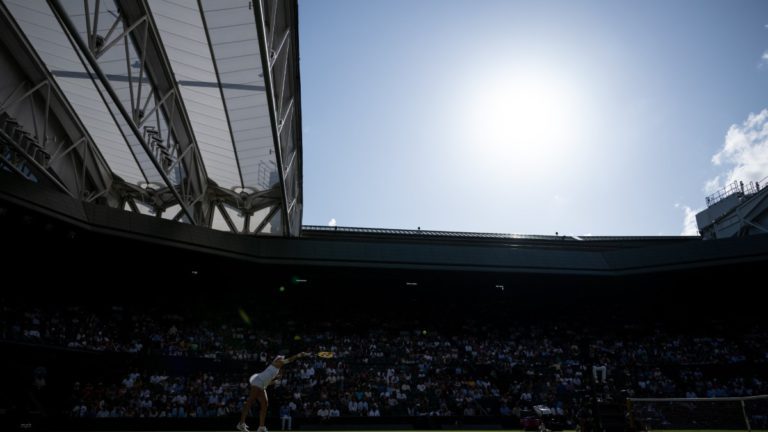
ENGLAND: In a comical turn of events at the oldest Grand Slam tournament, Wimbledon, the timing of Champagne popping caused a minor disruption on Sunday. 

As the players prepared for a match on No. 3 Court, an Australian umpire, John Blom, took the microphone to request that the spectators refrain from opening Champagne bottles during the players’ serves.

Anastasia Potapova, the 22nd-seeded player, received the umpire’s announcement with a smile and a nod. However, the mishap had already affected her game.

As she prepared to serve in her third-round match against teenager Mirra Andreeva, a Champagne cork popped just as she tossed the ball in the air, causing her serve to go long. Potapova lost the subsequent point on her second serve, adding to the humorous moment.

The All England Club offers Lanson Champagne on its grounds, allowing spectators to enjoy the popular beverage alongside the traditional strawberries and cream. 

Available by the glass, half-bottle, and bottle, the luxurious “Le White Label Sec” Champagne sells for £95.10 ($122) per bottle. Some spectators opt to bring their own Champagne, appreciating the club’s policy that permits personal bottles.

Sarah-Jane Watson, a lawyer from Surrey, shared her experience of bringing both her own bottle and purchasing one on-site. 

She and her husband enjoyed watching matches on No. 2 Court, though they were kindly asked by a security guard not to open the bottle inside. 

Meanwhile, on Centre Court, a cork could be heard popping between points during a match featuring Iga Swiatek and Belinda Bencic.

Marie Bouzkova, the 32nd-seeded player, shared her perspective on the distraction caused by the Champagne popping. The Czech Republic native, who lost to Marketa Vondrousova, mentioned her ability to stay focused during matches. 

In fact, she recalled a previous instance when she hadn’t noticed a fire alarm going off in a nearby building during a match. 

Bouzkova humorously remarked that the noise level at Wimbledon was relatively low compared to the boisterous crowds at Flushing Meadows in New York.

Despite the momentary interruptions caused by Champagne celebrations, the players demonstrated their professionalism and commitment to the game. 

Wimbledon, known for its traditions and the elegant ambiance it creates, continues to captivate tennis fans around the world.

As the tournament progresses, spectators will likely heed the umpire’s request and time their Champagne indulgence more thoughtfully, ensuring that the players can serve without any unexpected surprises. 

The combination of sporting excellence and the occasional light-hearted moment make Wimbledon a truly unique and memorable event in the world of tennis.

Also Read: Svitolina Triumphs over Azarenka in Epic Wimbledon Battle

NASA’s Supersonic X-59 Plane Moves Closer to Takeoff; Promising Quiet Supersonic Flights

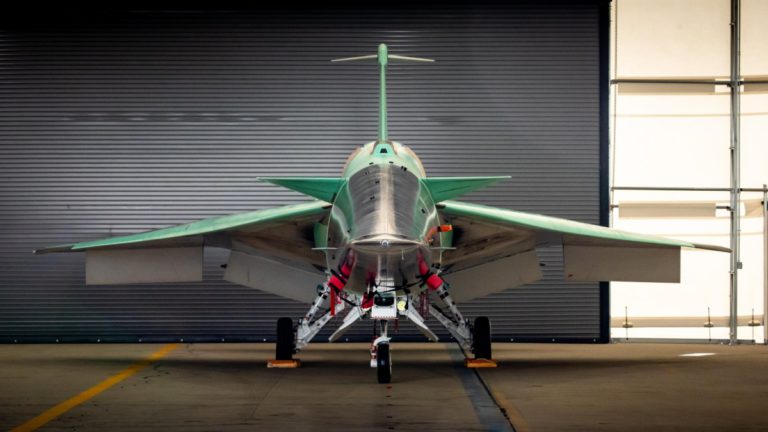
UNITED STATES: Excitement is building as NASA’s supersonic plane, the X-59, edges closer to its highly anticipated debut flight. Recent photos reveal the aircraft parked on the flight line at Lockheed Martin’s Skunk Works facility in Palmdale, California, marking a significant milestone in its preparation for takeoff.

The X-59, part of NASA’s Quesst mission, aims to revolutionize supersonic flight by eliminating the disruptive sonic booms associated with such aircraft. The ground tests following this crucial step will ensure the X-59’s safety and readiness for flight. 

The primary objective of the Quesst mission is to demonstrate that the X-59 can achieve speeds faster than the sound barrier (Mach 1) without generating the loud sonic booms typically associated with supersonic planes.

NASA plans to fly the X-59 over several communities to gather data on human responses to the sound generated during supersonic flight. 

By delivering this comprehensive dataset to U.S. and international regulators, NASA aims to pave the way for potential commercial supersonic flight over land.

Unlike previous generations of supersonic aircraft that rattled windows and caused disturbances, NASA has designed the X-59 to produce only a gentle thump, similar to the sound of a nearby car door slamming, for those on the ground. 

This noise reduction breakthrough could lead to new sound-based regulations for supersonic flight over land, potentially revolutionizing commercial cargo and passenger air travel. Throughout the ground and initial flight tests, the X-59 will remain stationed near the runway at Lockheed Martin’s facility. 

The aircraft measures 99.7 feet in length and 29.5 feet in width and is powered by a single jet engine manufactured by General Electric Aviation. Capable of reaching a speed of Mach 1.4 (925 mph) at an altitude of 55,000 feet (16,764 meters), the X-59 promises remarkable performance.

If everything proceeds according to plan, the X-59 will take flight over select U.S. cities starting in 2024. This unique opportunity will allow residents to share their responses to the aircraft’s sound profile, providing invaluable data for analysis. 

In 2027, when the Quesst mission concludes, the collected information will be shared with American and international regulators, potentially paving the way for the future of quiet supersonic travel.

As anticipation builds for this groundbreaking aircraft, aviation enthusiasts and industry professionals eagerly await the dawn of a new era in supersonic flight. 

The X-59 represents NASA’s dedication to advancing aeronautical technologies and shaping the future of aviation by making supersonic travel more accessible, efficient, and environmentally friendly.

Also Read: NASA Unveils AI Assistant for Astronauts to Communicate with Spacecraft

Max Verstappen Extends Winning Streak with Thrilling Victory at British Grand Prix

0

UNITED KINGDOM: In a thrilling display of skill and determination, Max Verstappen continued his winning streak at the British Grand Prix, securing Red Bull’s first victory at Silverstone in a decade. The race was marked by intense battles and strategic manoeuvring, with Verstappen emerging victorious.

The British crowd cheered as Lando Norris made an epic start from second place, overtaking Verstappen and taking the lead. However, their celebrations were short-lived, as Verstappen quickly regained his position at the front of the pack by lap 5. 

The reigning World Champion showcased his circuit mastery, executing a perfect DRS pass to reclaim the lead. While Verstappen faced a relentless challenge from Norris, the Red Bull driver gradually increased his lead. 

The race was not without its share of drama, with a late Safety Car period caused by Kevin Magnussen’s engine failure. This bunching of the field added further excitement to the already intense competition. Verstappen’s victory was a testament to his exceptional driving skills and the superiority of the Red Bull team. 

With all three tire compounds represented on the grid, the top five drivers opted for medium tires, except for George Russell in sixth place, who chose soft tires. 

As the race progressed, Verstappen overcame the DRS challenges posed by Norris and steadily built a commanding lead. Behind the leading duo, Charles Leclerc faced pressure from Russell, while Carlos Sainz battled Pierre Gasly. 

Starting from a disappointing ninth position, Lewis Hamilton displayed his trademark tenacity as he fought his way through the field. The race saw a mix of strategic pit stops and overtakes, adding to the spectacle on the track.

Nico Hulkenberg’s early pit stop due to a damaged front wing and Esteban Ocon’s retirement with a hydraulic leak further highlighted the challenging nature of the race. 

Verstappen faced some initial difficulties with his car’s handling but overcame them, while Norris showcased his skill and determination in defending his position against Hamilton’s relentless pursuit.

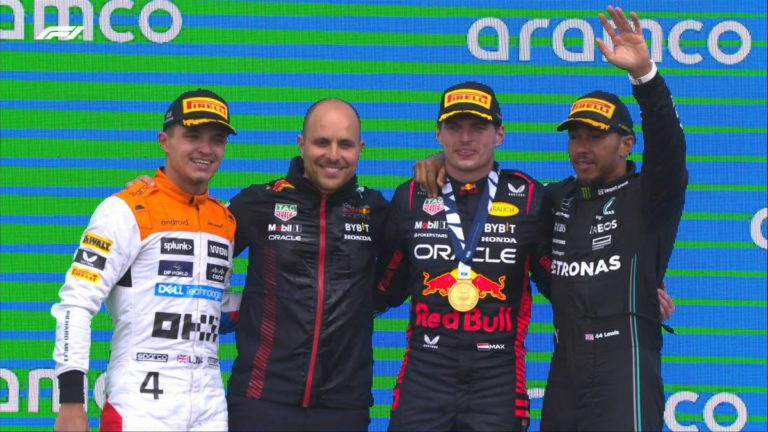
In the closing laps, Verstappen extended his lead over Norris, ultimately crossing the finish line 3.5 seconds ahead of the McLaren driver. 

The victory marked Verstappen’s sixth consecutive win, solidifying his position in the Drivers’ Championship with a 99-point lead over his teammate, Sergio Perez.

Hamilton, the home crowd favourite, secured a podium finish, taking third place. The young Australian driver Oscar Piastri impressed with a strong performance, finishing in fourth place, followed closely by Russell and Perez. Fernando Alonso, Alex Albon, Charles Leclerc, and Lance Stroll completed the top ten.

Also Read: Record-Breaking F1 2024 Calendar Unveiled with Saturday Night Races and Triple-Headers

Russell’s Paradox: The Mind-Boggling Self-Referential Conundrum of Classic Mathematics
INDIA: Russell’s Paradox is a fascinating logical puzzle that has perplexed mathematicians and philosophers for over a century.

Named after the renowned British philosopher and mathematician Bertrand Russell, this Paradox exposes a fundamental flaw in set theory and challenges our understanding of self-referential statements.

To understand Russell’s Paradox, let’s delve into the realm of sets. In set theory, a set is a collection of distinct objects, such as numbers, letters, or other sets. 

For example, we can have a set of fruits that includes apples, oranges, and bananas. Now, consider the set of all sets that do not contain themselves as elements. This condition is where the Paradox arises.

If we assume this set exists, let’s call it R, then we encounter a contradiction. If R contains itself as an element, it contradicts the assumption that R only has sets that do not contain themselves. 

On the other hand, if R does not contain itself as an element, it satisfies the condition of being in R, leading to another contradiction.

This Paradox arises from the idea of self-reference. In the case of R, it refers to itself in defining its membership criteria, creating a paradoxical situation where it cannot exist as a set. 

The Paradox questions the logical consistency of set theory and raises profound philosophical questions about the nature of sets and their definitions.

Bertrand Russell first discovered this Paradox in 1901 while working on the foundations of mathematics. It had significant implications for the logical and philosophical systems of the time. 

Russell’s Paradox demonstrated that certain assumptions in set theory could lead to contradictions, challenging the foundations of mathematics itself.

To resolve this Paradox, mathematicians and logicians developed various approaches, including axiomatic set theories that carefully defined the conditions for set formation. 

One of the most effective responses was the development of Zermelo-Fraenkel set theory (ZF), which provides a formal framework for set theory, incorporating axioms that avoid the Paradox.

ZF set theory avoids Russell’s Paradox by restricting the formation of sets in specific ways. It introduces the concept of the “axiom of regularity,” which ensures that no set can contain itself as an element. 

By carefully formulating the rules and axioms of set theory, mathematicians aim to create a consistent and coherent foundation for mathematics.

Beyond mathematics, Russell’s Paradox has also sparked philosophical debates about the nature of self-reference, logic, and the limitations of formal systems. 

The Paradox challenges our intuitive understanding of sets and raises profound questions about the boundaries of human knowledge.

Also Read: The Mind-Bending Gibbs Paradox: Exploring the Strange Behaviour of Mixing Identical Gases

Max Verstappen Outpaces Carlos Sainz in Thrilling FP2 Battle at British Grand Prix

0

UNITED KINGDOM: Max Verstappen emerged as the fastest driver in an exciting session of FP2 at the British Grand Prix, narrowly edging out Carlos Sainz for the top spot.

The Red Bull driver demonstrated his speed and skill, clocking an impressive time of 1:28.078 on soft tires, leaving the Ferrari driver trailing by a mere 0.022 seconds.

The session experienced a delayed start due to barrier repairs following the Formula 2 qualifying session. However, once underway, the drivers wasted no time in pushing their limits on the iconic Silverstone circuit.

Verstappen and his teammate, Sergio Perez, initially led the way on medium tires. McLaren’s Oscar Piastri also impressed, securing the third-fastest time, benefiting from upgrades introduced on his teammate Lando Norris’ car.

Last year’s race winner, Carlos Sainz, soon displayed his prowess by taking the top spot with a time of 1:29.083, leaving Perez trailing by three-tenths of a second.

However, Verstappen made a strategic move by switching to soft tires for his qualifying simulation run, reclaiming the lead with a time that was a whole second faster than Sainz’s.

Williams continued their impressive performance in FP2, with Alex Albon and Logan Sargeant securing top-five finishes. Albon, who already achieved a P3 finish in FP1, showcased his talent by lapping just two-tenths slower than Verstappen. The Williams team celebrated their success, indicating it was no coincidence.

The session progressed relatively smoothly despite minor setbacks for a few drivers, including Charles Leclerc’s electrical issue and Lance Stroll’s wing mirror problem.

Mercedes faced difficulties finding their rhythm, as George Russell and Lewis Hamilton finished in 12th and 15th places, respectively. The team will need to work on their setup overnight to improve before qualifying.

The session concluded dramatically with Nyck de Vries suffering a puncture and a heavily scratched floor, requiring him to limp back to the pits.

Verstappen maintained his dominance throughout the session, setting the fastest time. However, with more running scheduled for Saturday, the final grid positions for the British Grand Prix are still up for grabs.

Fans can anticipate an exhilarating battle between Verstappen and Sainz, as both drivers showcase their immense skill and determination.

The stage is set for a thrilling qualifying session that will determine the starting positions for Sunday’s highly anticipated race at Silverstone.

Also Read: Max Verstappen Whinging for More Money with Retirement Threat, Says George Russell