
Home Blog Page 84

Euro 5+ Emissions Standard to Implement in 2024

INDIA: The current Euro 5 emissions standard may be only three years old, but a new standard is already on the horizon. 

The Euro 5+ standard is set to take effect in 2024, refining the current emissions standards for motorcycles by introducing more advanced onboard diagnostics and durability tests.

While Euro 5 has already taken a toll on some manufacturers, Euro 5+ seeks to improve the standards further without significantly changing the existing limits. 

Passing the emissions tests alone will no longer be enough to meet the new criteria, and onboard diagnostics, durability tests, and noise tests will all play a crucial role in ensuring the standards are met.

While the emissions limits will remain the same, the durability testing for catalytic converters will significantly change. 

Under Euro 5, a mathematical deterioration calculation was acceptable, but Euro 5+ will require a kilometer-long test to see whether the components can hold up over time.

The OBD II level will also get an upgrade, with Euro 5+ requiring the ECU to run a check at least 10 percent of the time that the vehicle is in use, including checking the catalytic converter and the state of the sensors. 

The ECU’s diagnostic monitoring will also need to signal whether the vehicle operator cannot use the engine’s full power, such as because of an overheating motor.

Euro 5+ is not a complete revamp of the current standard but a refinement to ensure that criteria are met over the long term. 

Manufacturers may find the new standard less daunting than the transition from Euro 4 to Euro 5, as much of the work that went into the combustion system will only need a partial overhaul.

The new standard aims to reduce emissions further and protect the environment. 

By requiring advanced onboard diagnostics and durability tests, it ensures that motorcycles remain compliant with the emissions limits in the long run. 

However, the transition to Euro 5+ may also affect the cost of production, and some models may become casualties of the new standard, just as the Honda CB1100 was with Euro 5.

As Euro 5+ implementation approaches, how manufacturers will cope with the new requirements remains to be seen. 

However, with more advanced onboard diagnostics and durability tests, the new standard promises to improve the current emissions limits without a significant overhaul of existing systems.

As we move closer to the implementation of Euro 5+, it will be interesting to see how manufacturers adapt to the new requirements and how this new standard will affect the motorcycle industry.

Also Read: Audi Acquires Minority Stake in Sauber as Preparation for F1 Debut in 2026
IND vs AUS 2nd Test: Australia Takes Upper Hand after Indian Rear-guard Action

0

INDIA: In a day of absorbing cricket, Australia took the upper hand in the second innings shootout of the Delhi Test against India. 

India vs Australia

An exceptional performance led the visitors from off-spinner Nathan Lyon, who took four wickets in a devastating spell in the morning. India was left reeling at 66/4, but a rear-guard comeback led by Axar Patel and R. Ashwin allowed them to come back into the match.

Photo Credit: Twitter/BCCI

At stumps on day two of the second Test match, Australia led by 62 runs after some late-evening batting enterprise from Travis Head. He was promoted to open in the absence of a concussed David Warner and raced away to a brisk 39 runs off 40 balls, hitting five fours and a six. 

Usman Khawaja fell to Ravindra Jadeja, but Marnus Labuschagne kept up the scoring rate with some aggressive strokeplay. Lyon’s devastating spell of 9-1-21-4 had left India uncertain of their ability to chase down Australia’s first-innings score of 263. 

The off-spinner had the Indian batters struggling with his round-the-wicket approach, with their bat-and-pad-together style of play being put to the Test. Lyon’s spell was only blemished by some questionable reviews from Australia, who burnt all three of their DRS reviews.

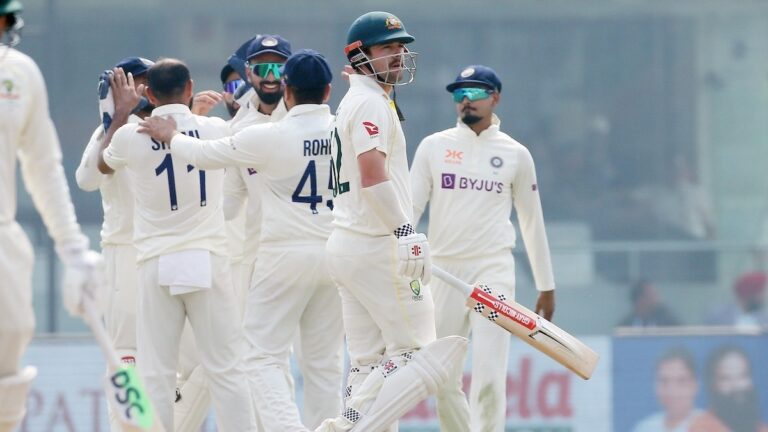
India captain Virat Kohli produced a mini-classic in his knock of 44, which proved to be a masterclass on countering the surface. However, his dismissal to debutant Matthew Kuhnemann was contentious, with replays being inconclusive in determining if the ball made contact with the bat or pad first. 

Australia
Photo Credit: Twitter/BCCI

Lyon took his 22nd five-wicket haul in Tests, becoming only the third man to take 100 wickets in Test matches against India, behind M. Muralitharan and James Anderson. However, India’s batting depth again came to the fore, with Patel and Ashwin demonstrating why they are such a formidable force in these conditions. 

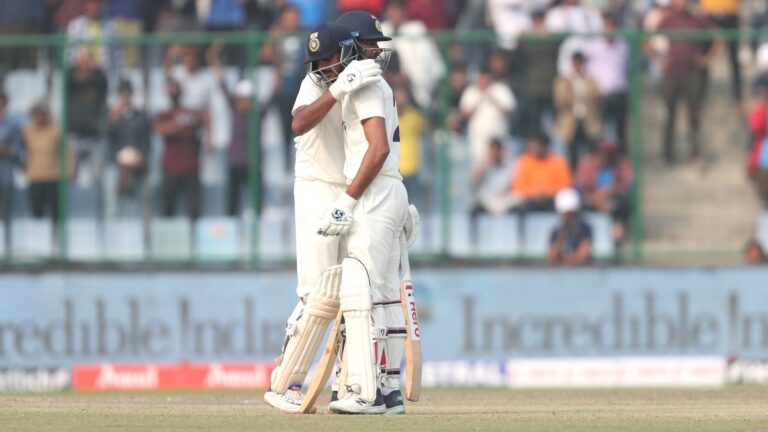
Patel took on the debutant left-arm spinner Kuhnemann and smashed him for a six and a pair of fours, while Ashwin handled the off-spinners expertly. The pair stitched together the first hundred-run partnership of the series, meaning that when the second new ball was made available, India was in arrears by only 11 runs.

However, any hopes of India sneaking a healthy lead were snuffed out by Australia. The visitors dismissed Ashwin on 37, with Matt Renshaw taking a sharp catch before Pat Cummins held on to a stunning catch at mid-on to end Patel’s valiant innings at 74. 

Indian inning eventually fell one run short of Australia’s total. The third day of the Test promises a thrilling battle for supremacy, with Australia leading by 62 runs with nine wickets in hand. 

India will be looking to take quick wickets, while Australia will aim to build on their lead and set a challenging target for the hosts. The match is finely poised, and cricket fans can expect another absorbing day of Test cricket.

Also Read: India Becomes the No. 1 Ranked Team Across All Formats

The Butterfly Effect: How a Small Action Can Cause a Big Impact

0

UNITED STATES: The butterfly effect is a concept that has been gaining popularity in recent years. It highlights the idea that even the slightest action can profoundly impact the future.

The butterfly effect is a scientific theory suggesting that a small action can significantly impact a complex system. 

The theory was first introduced by Edward Lorenz, an American mathematician and meteorologist, in the 1960s. 

Lorenz discovered that a slight change in one part of a system could result in a significant difference in another part of the system. 

He used the analogy of a butterfly flapping its wings in Brazil and causing a tornado in Texas to explain this theory.

Since then, the butterfly effect has been used to explain various phenomena, from weather patterns to economic trends. 

In recent years, it has also been applied to the world of social media and the internet, where a single tweet or post can significantly impact public opinion.

For example, a tweet by a celebrity endorsing a product can cause a surge in sales for that product, while a negative review by a famous blogger can lead to a significant drop in sales. 

The butterfly effect is also evident in politics, where a small decision by a government official can have a ripple effect on the global economy.

The butterfly effect is not only a scientific concept but also has practical applications in our daily lives.

Small actions such as recycling, using public transportation, or reducing energy consumption can significantly impact the environment. 

Similarly, acts of kindness or support towards others can positively impact their lives and the world at large.

Moreover, the butterfly effect has a significant impact on our mental health as well. 

Small changes in our daily habits, such as exercise, meditation, or journaling, can significantly impact our mood and overall well-being. 

Similarly, small acts of kindness, such as volunteering or donating to charity, can positively impact our sense of purpose and happiness.

As the world becomes increasingly interconnected, the butterfly effect is more relevant than ever. 

Our actions, no matter how small, can significantly impact the world around us. The butterfly effect reminds us that we are responsible for making positive changes in our lives and the world at large.

The butterfly effect is a powerful concept that highlights the impact of our small actions on the world. 

It serves as a reminder that our choices and decisions, no matter how insignificant they may seem, significantly impact the future. 

By being mindful of our actions and their impact, we can make positive changes in our lives and the world around us. So let us all flap our wings and create a positive ripple effect in the world.

Also Read: NASA Gives the Mars Mission Contract to Blue Origin

India vs Australia 2nd Test: Aussies Post 263 before India Fend Off 9-overs

0

INDIA: Australia’s batters put 263 runs on the scoreboard in their first innings of the second Test match against India. Pat Cummins won the toss and opted to bat first. 

India vs Australia

Usman Khawaja scored 81 runs, while Peter Handscomb contributed an unbeaten 72 as the visitors displayed their prowess against India’s spin attack.

However, Australia’s openers struggled to find their rhythm against India’s seamers. Warner was troubled by Mohammed Siraj, who produced an excellent six-over spell, while Khawaja got off to a brisk start. The visitors lost their first wicket when Shami put Warner out of his misery.

Marnus Labuschagne joined Khawaja, and the two combined for a counter-attack against India’s spinners. Khawaja played both the conventional and reverse sweeps against Ashwin and mixed those up by stepping out and lofting the offspinner over long-off for a six.

The wily spinner, Ashwin, eventually got Labuschagne out before lunch with an off-break that spun past his defence. Before lunch, the hosts almost had Khawaja, too, when he missed a flick against Ravindra Jadeja, but an intelligent review saved him.

India
Photo Credit: Twitter/BCCI

Australia continued to score at a good pace, with Handscomb and Khawaja joining forces to keep India at bay. Handscomb was very assured with his technique and, against a softened ball, was happy to stay back and play off the back foot.

Eventually, a moment of fielding brilliance brought the hosts respite, with Khawaja falling for 81 to Jadeja. 

The hosts then added another wicket when Alex Carey edged Ashwin to slip. At 168/6, there were fears of the lower-order caving once more to a sub-200 total, but Pat Cummins and Handscomb allayed those fears with another half-century stand. 

The right-handed Handscomb, who last scored a Test match half-century in 2017, was reprieved right at the end when Jadeja overstepped and remained unbeaten on 72.

India faced a tricky nine-over period before the close of play. Still, Rohit Sharma and KL Rahul saw it through, despite a couple of nervy moments against debutant left-arm spinner Matthew Kuhnemann.

Also Read: IPL 2023 Schedule is Expected to be Revealed Today at 5 PM

Bruce Willis’ Diagnosed with Frontotemporal Dementia, Family Shares Heartbreaking News

UNITED STATES: Bruce Willis, the 67-year-old actor known for his roles in blockbuster hits like Die Hard and The Fifth Element, has been diagnosed with frontotemporal dementia, his family announced on Thursday. 

The diagnosis comes nearly a year after his family announced that Bruce Willis would retire from acting due to a diagnosis of aphasia. This condition causes a loss of the ability to understand or express speech.

Bruce Willis’ family posted a statement on the Association for Frontotemporal Degeneration website, saying that his “condition has progressed.” 

The statement said that he now has a more specific diagnosis of frontotemporal dementia. Frontotemporal dementia is a brain disorder caused by degeneration of the brain’s frontal and/or temporal lobes. The frontal and temporal lobes affect behaviour, language, and movement.

The family’s statement described frontotemporal degeneration as a “cruel disease” that many people have never heard of and that can strike anyone.

According to the Association for Frontotemporal Degeneration, the average life expectancy of people after the onset of symptoms of frontotemporal degeneration is seven to thirteen years. 

Bruce Willis’ family, including his wife Emma Heming Willis, his ex-wife Demi Moore, and his five children, called for more awareness and research into the disease, which they said can take years to get a proper diagnosis.

Over a four-decade career, Bruce Willis’ movies earned more than $5 billion at the worldwide box office. In recent years, he has primarily featured in direct-to-video thrillers.

News of Willis’ diagnosis has drawn an outpouring of support from fans and colleagues. Many have taken to social media to express their sadness and offer encouragement.

As Willis and his family face this difficult time, the world is coming together to show their support and raise awareness for frontotemporal dementia.

Also Read: Tayyip Erdogan Pledge to Quicken Rescue Work Following Turkey’s Earthquake

Steelbird Launches SBH-40 Mamba: The Ultimate Combination of Style and Safety

0

INDIA: Steelbird, one of India’s leading helmet manufacturers, has launched its latest helmet model, the SBH-40 Mamba, which promises to deliver both style and safety. 

The new SBH-40 model, from the company’s Aeronautics series, has been designed with a funky look and is made from aerodynamic thermoplastic shells.

The SBH-40 Mamba boasts a range of features that make it stand out from other helmets on the market. 

The helmet has a high-density EPS and a polycarbonate visor with an anti-scratch coating, which promises to protect the rider from any impact.

The helmet is available in three sizes: medium, large, and XL, and it comes in vibrant colours and graphics, making it an excellent choice for riders who want to stand out on the road. 

The price of the SBH-40 Mamba starts at Rs. 1799 for the medium-end interior, while the helmet with a single visor and high-end interior decal starts at Rs. 2199.

One of the standout features of the SBH-40 Mamba is its airflow ventilation system, which ensures better air ventilation throughout the helmet. This system helps keep the rider comfortable during long rides. 

The Steelbird SBH-40 Mamba also has an air tunnel in the EPS for added ventilation.

The helmet’s interior is made from high-quality materials. It comes in two versions: a medium-end replaceable interior with a comfortable fit, and a high-end replaceable interior with long cheek pads for a snug fit. 

The high-end interior also features a high-frequency tool-made wind deflector. On the other hand, the medium-end interior features a standard wind deflector.

The SBH-40 Mamba comes with a quick-release buckle that meets European standards and a quick-release visor mechanism, making it easier for the rider to wear and remove the helmet. 

The helmet is also available in two versions, one without a sun shield and the other with a drop-down inner sun shield to protect against the sun’s rays during daytime rides.

A nose protector adds an extra layer of safety to the helmet, making it a must-have for riders who prioritise their safety on the road. 

Steelbird’s latest helmet is designed to have a classy look and comes with polycarbonate and resin slips on the lateral part of the visor.

The SBH-40 Mamba promises to offer unrivalled safety standards, superior quality, effective performance, and advanced technology.

Rajeev Kapur, Managing Director of Steelbird Helmets, rightly said that helmets are essential products that save lives regardless of whether the person is a rider or a pedestrian. 

The SBH-40 Mamba is a must-have for riders who want to combine style and safety in one package.

Also Read: Hot-wired: Nvidia RTX 4090 Melts Power Connectors 

Chelyabinsk Meteor Strike: The Risks of Asteroids Hidden in the Sun’s Glare

0

RUSSIA: On February 15, 2013, a massive asteroid entered the Earth’s atmosphere, causing a powerful explosion over the Russian city of Chelyabinsk. 

The blast shattered windows, damaged buildings, and injured over a thousand people. 

The event, known as the Chelyabinsk meteor strike, was a stark reminder of the potential dangers posed by space rocks and the urgent need to detect and track them.

Just like the Chelyabinsk meteor, which astronomers and space agencies could not detect, many asteroids are hidden from human view in the sun’s glare. 

These space rocks, known as near-Earth objects (NEOs), are difficult to detect using traditional telescopes and require advanced technology and sophisticated algorithms to be identified and tracked.

According to NASA, there are over 25,000 NEOs in the solar system, many of which remain undiscovered. 

The agency estimates that it has identified only about one-third of the total number of NEOs larger than 140 metres (460 feet), which are considered potentially hazardous to the Earth.

To address this challenge, NASA has launched several programmes to detect and track NEOs, such as the Near-Earth Object Wide-field Infrared Survey Explorer (NEOWISE), which uses an infrared telescope to search for asteroids that are invisible to optical telescopes.

NEOWISE has already discovered over 1,000 previously unknown NEOs, including several potentially hazardous asteroids. 

One of them, called 2016 WF9, caused some alarm among conspiracy theorists in 2017 when it was falsely rumoured to be a rogue planet on a collision course with Earth.

In reality, 2016 WF9 is a small, dark asteroid about 1 kilometre (0.6 miles) in diameter that orbits the sun on a highly elongated path that takes it from beyond Mars to the inner solar system. 

The asteroid is not considered a threat to the Earth and passed safely by our planet on February 25, 2017, at a distance of about 51 million kilometres (32 million miles).

However, the incident highlights the importance of accurate information and public education about NEOs, which can help prevent unnecessary panic and promote preparedness in case of a real threat.

In addition to NASA’s efforts, other organisations and countries are also working on NEO detection and mitigation. 

For example, the European Space Agency (ESA) has launched a mission called Hera, which aims to study and deflect a binary asteroid system called Didymos.

Didymos consists of two asteroids, one about 780 metres (2,560 feet) in diameter and the other about 160 metres (525 feet) in diameter, that orbit each other. 

The Hera mission, scheduled for launch in 2024, will send a spacecraft to study and impact the smaller asteroid to alter its orbit and test the effectiveness of asteroid deflection techniques.

Overall, the Chelyabinsk meteor strike and the ongoing efforts to detect and mitigate NEOs serve as a wake-up call to the world about the potential dangers and opportunities of space exploration. 

While there are many challenges and uncertainties ahead, there is also a tremendous potential for scientific discoveries, technological innovations, and global cooperation in the quest to understand and protect our planet and its inhabitants.

Also Read: NASA Gives the Mars Mission Contract to Blue Origin

Ferrari Unveils 2023 F1 Challenger, the SF-23, at Maranello Factory Launch Ceremony

0

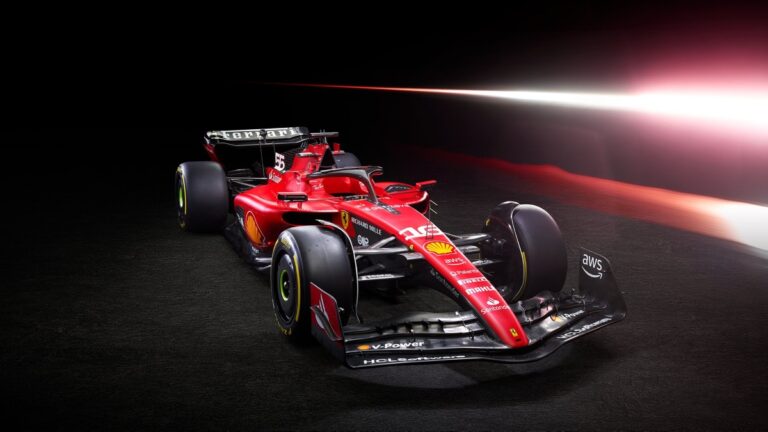
ITALY: Ferrari has unveiled its 2023 F1 challenger, the SF-23, at a launch ceremony held at their Maranello factory. 

The event was attended by 2022 runner-up Charles Leclerc, Carlos Sainz, and new team boss Frederic Vasseur. 

The SF-23 is an evolved version of last year’s F1-75 and was revealed to a jubilant audience at the Fiorano test track in a “mini-concert” format. 

The launch included a violin-led rendition of the Italian national anthem, and the new car hit the track at Fiorano straight after the ceremony. 

Leclerc was the first to drive the car, and after two laps, he gave his feedback to the engineers. 

The team will carry out 100 kilometres of track time, split between Leclerc and Sainz, with the Spaniard getting his chance a little later on Tuesday.

The launch ceremony took place just over a week before the pre-season F1 testing in Bahrain. 

Ferrari intends to fight for the 2023 F1 titles with the SF-23. The car has already created a buzz among the tifosi and F1 enthusiasts, and Leclerc’s words prove the new car’s excitement. 

He said that the car felt special and that everything went smoothly. He could only give a few details about the runs since he could do only two laps.

However, he added that he gave the engineers feedback. “The car was running well, smooth, everything went really well,” Leclerc said.

The launch event included a short chat about the drivers’ winter breaks and the introduction of the new team boss Frederic Vasseur. 

The event teased the audience with the new Ferrari engine fire-up audio. The SF-23 is an evolution of Ferrari’s last year’s F1-75, which was extremely competitive at the beginning of the season. 

Ferrari hopes the new car will take them to the top of the leaderboard in the coming 2023 F1 season.

The launch ceremony at Fiorano was a thrilling event that generated a lot of excitement among the tifosi. 

Leclerc’s words reflect the passion and excitement surrounding the new car. Ferrari has a rich history in F1, and the SF-23 is expected to be another milestone in the team’s long and illustrious history. 

The car has already generated a buzz among F1 enthusiasts, and the launch ceremony was a fitting way to introduce the car to the world. 

Ferrari hopes to take the chequered flag with the SF-23, and F1 fans worldwide are waiting eagerly to see how the car performs on the track.

Also Read: Mercedes Reveals Their 2023 F1 Car with Eagerly Anticipated Black Livery

String Theory: The Theory That Ties Everything Together

0

INDIA: String theory has been around for almost 50 years, but the complex and elusive nature of the theory has left many people scratching their heads. 

However, recent advances in the field have brought this theoretical framework into the spotlight, promising to revolutionise our understanding of the universe.

At its core, string theory seeks to reconcile the two most successful but conflicting views of physics: general relativity, which explains gravity on a large scale, and quantum mechanics, which explains the behaviour of subatomic particles. 

The problem is that these two theories cannot be reconciled by logic, meaning we cannot use them to explain the universe at the smallest and largest scales.

String theory proposes a new way of looking at the universe: everything consists of tiny, vibrating strings. 

These strings are incredibly small, too small to be detected by any existing technology. The theory suggests that the strings vibrate at different frequencies, giving particles their mass, charge, and other properties.

One of the most promising aspects of string theory is that it suggests the existence of multiple dimensions beyond the three we are familiar with in real-life applications. 

The theory proposes that there are ten dimensions in total: the four dimensions of space-time that we experience in our everyday lives, plus six additional dimensions that are curled up and invisible to us. 

These extra dimensions could explain why gravity is so much weaker than the other fundamental forces of the universe, and they could help us understand the mysterious dark matter that makes up a significant portion of the universe.

However, string theory is far from a complete theory. 

There are many different versions of string theory, each with its own set of mathematical equations and predictions. Some of these predictions are testable, while others are not. 

So far, no experimental evidence supports the theory, and it remains a highly speculative and controversial idea in the scientific community.

Despite the lack of concrete evidence, string theory has become an incredibly influential idea in physics. 

String theory has inspired new research avenues and led to many important discoveries. 

For example, the theory of holography, which suggests that our three-dimensional universe could be a projection of a two-dimensional surface, was inspired by string theory. 

The theory of holography has led to significant developments in black hole physics and could have implications for our understanding of the universe.

String theory is also a source of controversy and debate. Some physicists argue that the theory is too abstract and mathematical to be considered a valid scientific theory. 

Others point out that the lack of experimental evidence means that the string theory cannot be considered a complete theory. 

However, many scientists remain optimistic about the future of string theory and its potential for advancing human understanding of the universe.

As with any scientific theory, the future of string theory is uncertain. It may turn out to be a dead end or lead to new discoveries that revolutionise our understanding of the universe. 

One thing is for sure: the idea of a universe made up of tiny, vibrating strings is captivating and thought-provoking. It will continue to capture the imagination of scientists and the public alike.

Also Read: NASA’s James Webb Telescope Captures a Galactic Crowd

Shoichiro Toyoda, Toyota’s Honorary Chairman and Expansion Pioneer, Passes Away at 97

0

JAPAN: The world of automobiles mourns the passing of Shoichiro Toyoda, the man who helped transform Toyota from a humble Japanese carmaker into a global automotive powerhouse.

The company’s honorary chairman passed away on Tuesday, aged 97, due to heart failure.

As the eldest son of Toyota’s founder, Kiichiro Toyoda, Shoichiro took the company’s reins in 1982 as its president. 

During his tenure, he led Toyota’s expansion into international markets, especially in the critical U.S. market, where the brand’s reputation for quality, durability, and engineering finesse became legendary.

Father and son, Shoichiro and Akio, faced the challenging years of “Japan-bashing” in the 1980s, when Japanese exporters were accused of taking away American blue-collar jobs. 

The father-son duo worked hard to show Toyota’s commitment to the American auto community, creating jobs and value for the American people.

Together with his brother Tatsuro, Shoichiro played a crucial role in establishing Toyota’s manufacturing facilities in North America. 

In 1983, the company formed a joint venture with General Motors to set up New United Motor Manufacturing Inc. (NUMMI) in Fremont, California, which rolled out its first vehicle the following year.

Shoichiro Toyoda’s legacy and charisma helped Toyota weather many crises over the years, even though the company had many chief executives who were not part of its founding family. 

In 2007, he was inducted into the U.S. Automotive Hall of Fame in recognition of his contributions to cementing Toyota’s reputation as one of the world’s leading automakers.

According to Toyota, Shoichiro earned the respect of his fellow employees by working alongside them in factories. 

His commitment reflected the company’s commitment to valuing the workplace and what is happening on the ground, known as “genba,” as critical for morale, efficient production, innovation, and quality.

From its humble beginnings when Kiichiro Toyoda first expressed his desire to build cars in 1933, Toyota has come a long way. 

Today, the “Toyota Way” is widely recognised as the best production method in the auto industry. 

Toyota’s portfolio includes some of the world’s most popular and beloved models, such as the Prius hybrid, the Camry sedan, and the Lexus luxury line.

Shoichiro Toyoda’s family held a funeral for him, and a “farewell” event in his honour is being planned for a later date. 

The automotive world has lost a visionary leader. Still, Shoichiro Toyoda’s legacy will undoubtedly continue to inspire future generations of Toyota employees to uphold the company’s values of innovation, quality, and commitment to the people.

Also Read: Audi Acquires Minority Stake in Sauber as Preparation for F1 Debut in 2026