
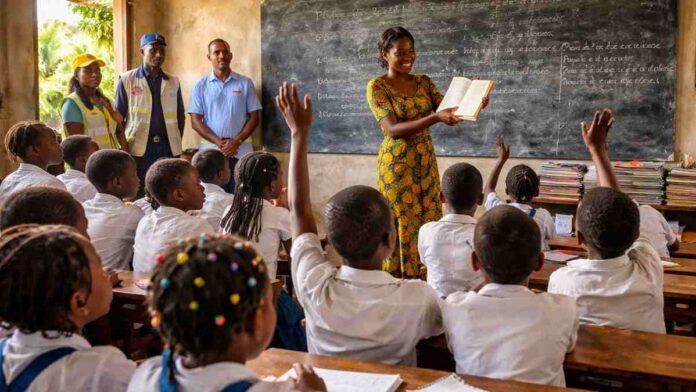
THE DEMOCRATIC REPUBLIC OF THE CONGO: The education system in the Democratic Republic of the Congo is undergoing a significant transformation as the government intensifies efforts to ensure access to quality education for all children. Long challenged by economic constraints, infrastructure gaps, and regional disparities, the country is now taking measurable steps to improve enrolment, retention, and learning outcomes across its provinces.
In recent years, the Congolese government has placed education at the center of its national development agenda. A landmark move came with the introduction of free primary education, a policy that has already led to a surge in school enrolments. Millions of children who were previously unable to attend school due to financial barriers are now entering classrooms, marking a pivotal shift in the country’s educational landscape.
Also Read: From Village Struggles to City Dreams Aarti Tiwari’s Journey of Resilience
However, the rapid increase in student numbers has also exposed systemic challenges. Overcrowded classrooms, shortages of trained teachers, and limited access to learning materials remain pressing concerns. In many rural and conflict-affected regions, schools continue to operate with minimal infrastructure, sometimes lacking basic facilities such as desks, electricity, or clean water.
To address these issues, the government has been working closely with international organizations such as UNICEF and World Bank. These partnerships are focused on improving school infrastructure, training educators, and ensuring that vulnerable children, including girls and displaced populations, have equal access to education. Programs aimed at building classrooms and supplying teaching materials are already underway in several provinces.
Teacher training has emerged as a key priority in the reform process. Authorities are investing in professional development programs to equip educators with modern teaching methods and improve classroom management. At the same time, efforts are being made to ensure timely payment of teacher salaries, a longstanding issue that has affected morale and performance within the sector.
Another critical aspect of the government’s strategy is promoting gender equality in education. Despite progress, girls in certain regions still face cultural and economic barriers that limit their access to schooling. Campaigns encouraging girls’ education, along with community engagement initiatives, are helping to shift attitudes and increase female enrolment rates.
Digital education is also gaining attention as a potential solution to some of the country’s structural challenges. Pilot programs introducing technology in classrooms are being tested in urban centers, with the aim of expanding access to digital learning tools in the future. While connectivity remains limited in many areas, these initiatives signal a forward-looking approach to education reform.
The government is also addressing the impact of conflict on education, particularly in eastern regions where instability has disrupted schooling for thousands of children. Temporary learning spaces and accelerated education programs are being introduced to help affected students catch up on lost time and reintegrate into the formal education system.
Despite the challenges, education experts note that the progress made so far is encouraging. The commitment shown by the government, combined with international support, is gradually laying the foundation for a more inclusive and resilient education system.
As the Democratic Republic of the Congo continues its journey toward universal education, sustained investment and policy consistency will be crucial. Ensuring that every child not only attends school but also receives a quality education remains the ultimate goal, one that holds the promise of long-term social and economic transformation for the nation.
Also Read: Dr. Vijay Patil Advances Scientific Research Through Biometric and Big Data Studies